UPDATE
AI Is the Baseline Now. What Actually Differentiates LegalTech Now?
Most legal professionals already use AI, but the real challenge (and differentiator for LegalTech) has shifted from adoption to implementation: fitting workflows, integrating systems, governing use, and delivering measurable value beyond the demo.
Share article
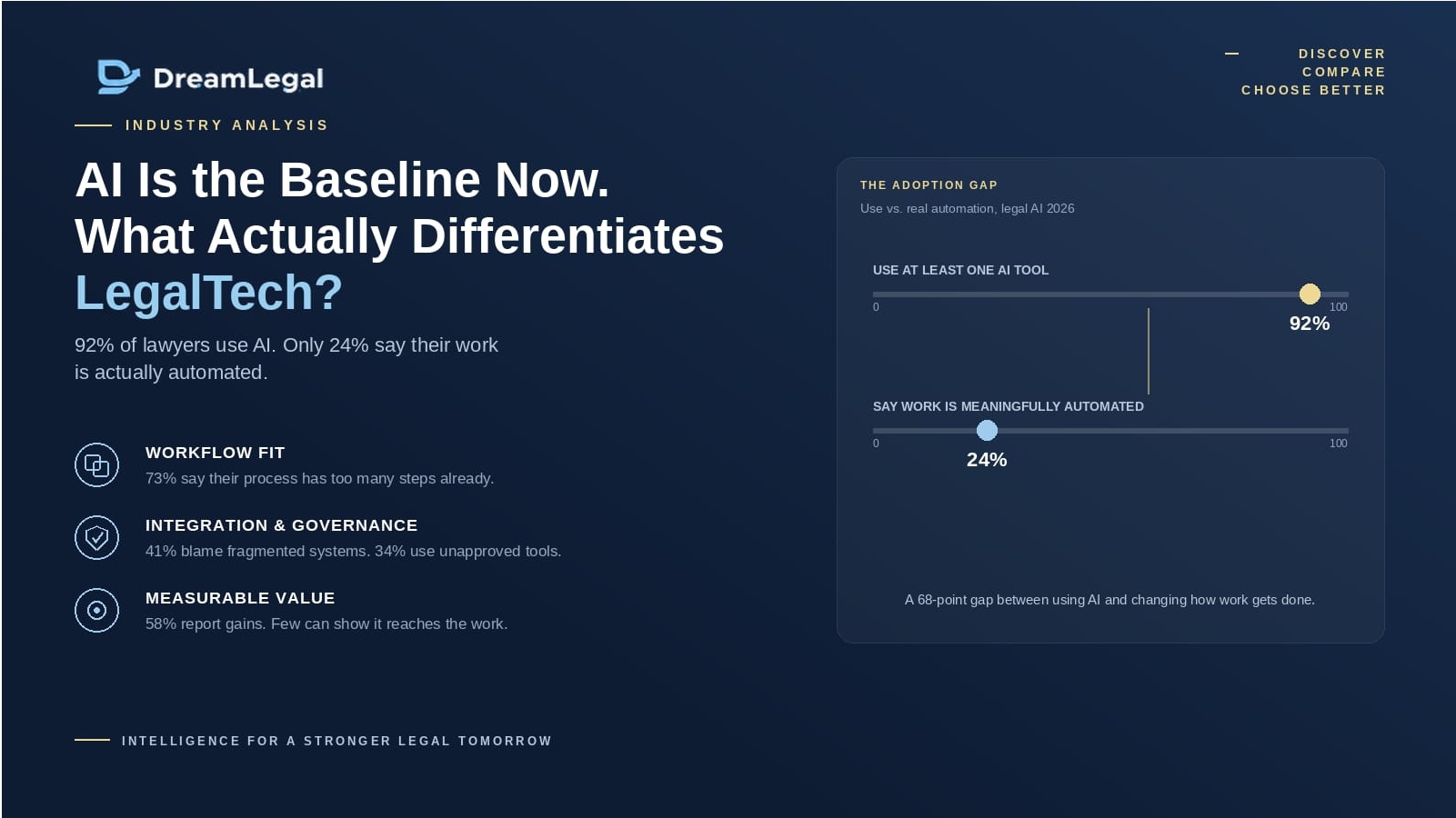
AI is the baseline now
Ninety-two per cent of legal professionals use at least one AI tool, according to Wolters Kluwer's 2026 Future Ready Lawyer report.[1] The report calls AI a baseline tool for the profession, in use across law firms, corporate legal departments and business consulting practices.[1]
Treat the exact figure with some care. Wolters Kluwer surveyed 810 lawyers in the US, China and eight European countries.[1] Progress surveyed 304 US lawyers and landed on 85%.[3] Different samples and different questions, but the same message: most lawyers are already using AI.
That changes what a product claim is worth. When most of the market has AI, "we have AI" tells a buyer very little. The more useful question is what happens around it.
The problem has moved from adoption to implementation
Consilio's 2026 Global Survey puts numbers on the shift. For the first time in six years, technology strategy has overtaken workload volume as legal's top strategic challenge.[2]
54% say understanding, selecting and deploying legal technology is now their top strategic challenge[2] | 58% report measurable productivity gains from AI adoption[2] | 41% cite fragmented systems as their biggest technology barrier[2] |
Source: Consilio, 2026 Global Survey Report.[2]
Both halves of that picture are real. Over half of respondents report measurable productivity gains, and a large minority are held back by fragmented systems.[2] Consilio describes fragmented platforms, manual workarounds and disconnected data as the hidden cost of rapid adoption, and says each new AI capability improves a workflow while the combined effect is more complexity.[2] It also describes governance maturity as low.[2]
So legal isn't only asking whether to use AI any more. It's asking how to select, integrate, govern and scale it.
AI adoption does not mean workflow transformation
Progress's State of Legal 2026 report makes the gap easiest to see. Eighty-five per cent of lawyers use AI, yet 77% say much of their work remains manual and 73% report workflows with too many steps.[3] Eighty-four per cent say inconsistent processes across teams or systems reduce efficiency.[3] Only 24% say a significant portion of their daily work is automated.[3]

Figure 1. High AI use alongside manual, fragmented work. Source: Progress, State of Legal 2026 (304 US lawyers).[3]
The same survey found that 82% say automation has improved their working lives, and that integration challenges, budget constraints and security concerns are the main barriers to doing more.[3] Nearly half (47%) say client intake takes four days or longer.[3] Fifty-two per cent say they feel effective but not efficient, because of manual tasks, unnecessary handoffs and fragmented systems.[3]
Progress sells software into this problem, so weigh its framing accordingly. Its own reading is that firms are layering AI on top of broken, manual processes instead of rethinking how work gets done.[3] Thomson Reuters reaches a similar place from a different direction: for many law firms, AI has changed which tools lawyers use without yet changing how matters are run, how work is staffed or how value reaches the client.[7]
The distinction matters for anyone choosing technology. A tool can produce a good summary, draft or research note while the process around that task stays exactly as fragmented as before. AI capability and workflow transformation are different things.
So what actually differentiates LegalTech?
The research points to five areas. None of them is a universal moat, and the sources don't claim one. Together they describe where buyers are running into trouble.
A. Workflow fit
Seventy-three per cent of lawyers already report workflows with too many steps, and 95% want technology that is simple, intuitive and free of unnecessary features.[3] A product that forces a team to build a new process around it adds to the load it was bought to reduce. Thomson Reuters' advice to law firm leaders is to embed AI into workflows at practice level, where changes to quality, speed and commercial return become visible and measurable.[7]
B. Integration
Forty-one per cent name fragmented systems as their biggest technology barrier.[2] Progress lists integration challenges among the top barriers to broader automation,[3] and Wolters Kluwer's respondents include difficulty integrating AI into existing processes among the main obstacles.[1] A technically impressive product that sits apart from the systems, documents and data around it is one more disconnected tool, which is the pattern Consilio warns about.[2]
C. Trust and governance
Ethical concerns and data privacy are joint top barriers to further AI adoption in the Wolters Kluwer survey, at 39%, alongside inadequate training. Resistance to change and cybersecurity are each cited by 35%.[1]

Figure 2. Top barriers to AI adoption in legal. Source: Wolters Kluwer, Future Ready Lawyer 2026 (810 respondents).[1]
Governance gaps show up in behaviour. Thirty-four per cent of law firm professionals say they use AI tools their firm hasn't authorised,[7] and 36% of lawyers in the Progress survey cite a lack of governance or training as an ongoing challenge.[3] One commentator quoted by Wolters Kluwer argues that bans don't work: without secure, approved tools, lawyers will find their own.[1] In-house teams, for their part, overwhelmingly prefer supervised, human-in-the-loop automation.[5]
D. Implementation
The demo is the easy part. Law firm professionals name the same obstacles to moving forward: the right tools not yet in place (41%), people not yet equipped (39%) and a strategy that is invisible in day-to-day work (50%).[7] Inadequate training sits at 39% in the Wolters Kluwer data.[1]
Thomson Reuters' stand-out lawyer research is specific about what helps. Clear information on tool accuracy and how to verify outputs is the biggest barrier for limited adopters, and training works best when it is built around real use cases. Giving people more time to experiment, the most common request, is unlikely to lift adoption on its own.[6] The ownership question has an answer too: legal operations is increasingly responsible for technology evaluation and selection, training and data management.[4]
E. Adoption and measurable value
Uneven adoption is the most common pattern in Thomson Reuters' law firm data, and it creates a variable client experience.[7] Only 24% of lawyers in the Progress survey say a significant portion of their daily work is automated.[3] On measurement, the stand-out lawyer research urges firm leaders to look beyond hours saved to value metrics: faster turnaround, better risk identification, consistency, client satisfaction and capacity for additional work.[6]
Time saved is real and widely reported. Sixty-two per cent of Wolters Kluwer respondents save between 6% and 20% of their week,[1] and 58% of Consilio respondents report measurable productivity gains.[2] The harder question for a buyer is whether that carries through into work that has actually changed.
The buyer is becoming more sophisticated
The Thomson Reuters 2026 Legal Department Operations Report found that the share of general counsel naming technology a strategic priority doubled between 2025 and 2026.[4] It describes legal operations as having grown from specialist IT support into a function that can cover technology evaluation and selection, training, legal project management and data management, and as increasingly positioned to translate technology and process improvements into measurable business outcomes.[4] AI pressure is landing on that function, which the report calls the default first line of defence.[4]
The pressure comes from above. Among corporate legal professionals in the Future of Professionals data, 61% report some or significant pressure from internal stakeholders to adopt AI faster, and 58% report financial pressure to do so.[7]
Read together, these findings suggest the buyer's question is changing. It's less "which tool has the most impressive AI?" and more "where does this fit, what does implementation need, and what value will it create?" That is our reading of the data rather than a finding the report states.
Law firms face the same translation problem
Thomson Reuters' 2026 Stand-out Lawyers research draws on 116 interviews with law firm leaders and managing partners and 2,527 lawyers nominated by clients as stand-out performers.[6] Nearly 80% of those lawyers believe their practice has a clear plan for AI integration, yet less than half are confident in their practice area's ability to succeed as AI becomes more integrated.[6]

Figure 3. Share of stand-out lawyers who strongly agree. Source: Thomson Reuters Institute, 2026 Stand-out Lawyers Survey (2,527 lawyers).[6]
The strongest-agreement figures show how quickly confidence drops as the question moves from strategy to commercial reality. Thomson Reuters' diagnosis is that law firms don't have an AI strategy problem in the abstract. They have a translation problem.[6] Having a strategy and operationalising it are different achievements.
Clients are noticing. In the Future of Professionals data, 77% of clients say AI-enabled quality improvements from their firms are very important or essential, but only 5% say they are getting them from most or all providers. Seventy-one per cent of in-house legal professionals expect firms to change their commercial model as AI use grows, while 28% of law firms say they have changed pricing at all.[7]

Figure 4. The expectation gap between clients and law firms. Source: Thomson Reuters Institute, Future of Professionals 2026 (736 law firm professionals; 203 corporate legal professionals).[7]
The report's foreword puts the conclusion in a sentence: the firms building real advantage are the ones operationalising AI, not the ones talking about it.[7]
The in-house view: moving past experimentation, with guardrails
LegalOn and In-House Connect surveyed 452 in-house legal professionals. Fifty-two per cent of teams are already using or evaluating AI for contract review, and active use has nearly quadrupled since 2024.[5] Seventy-nine per cent report less time spent on routine legal tasks and 67% say AI helps them respond faster to the business.[5]

Figure 5. In-house teams: adoption, outcomes and agents. Source: LegalOn and In-House Connect, 2026 State of AI for In-House Legal (452 respondents).[5]
Agents are the next question. Eighty per cent of teams are exploring or evaluating AI agents, and they overwhelmingly prefer supervised, human-in-the-loop automation.[5] The authors frame the shift as one from experimentation to how AI can be evaluated, governed and scaled safely across everyday legal work.[5] LegalOn sells contract review software, which is worth bearing in mind alongside the figures.
The Next Challenge Is Making AI Work
The evidence above points to a market with plenty of AI, but far less clarity about how to use it well. More than half of respondents in Consilio’s survey identify selecting and deploying legal technology as their top strategic challenge.[2] Thomson Reuters similarly warns that firms rushing to relieve AI pressure by adopting any available tool, without first asking whether it is the right fit for the work, risk consequences for client trust, work product and their own liability exposure.[7]
As the number of LegalTech products and AI capabilities continues to grow, the challenge for buyers is no longer simply finding a tool. It is understanding what to do with the choices in front of them.
That means being able to answer practical questions:
- What problem does a product actually solve?
- Where does it fit within an existing legal workflow?
- How does it compare with the alternatives?
- What does implementation require?
- What risks and limitations should be considered?
- What does successful adoption look like in practice?
This is where the role of a buyer-side layer becomes increasingly relevant. Legal teams need more than access to technology. They need context around the technology they are evaluating, the workflows it can support, the trade-offs involved and what adoption looks like beyond the product demo.
This is the space DreamLegal operates in, helping law firms and legal departments make more informed technology decisions as the market becomes increasingly crowded. The opportunity is not simply to add another source of LegalTech information, but to make the process of choosing, evaluating and adopting technology more structured and useful for the people expected to make it work.
What this means for LegalTech vendors
If AI capability is common, vendors will need to show more than technical capability. The research suggests buyers will be looking for answers to six questions:
• Where does the product fit into legal work?[3][7]
• How does it integrate with existing systems?[2][3]
• How does implementation work?[6][7]
• How are users supported and trained?[1][6]
• How are trust and governance addressed?[1][3][7]
• What measurable improvement does it create?[2][6]
The strongest demo may not turn into the strongest adoption. In the Progress data, high AI use and low automation sit side by side,[3] and in Thomson Reuters' law firm data adoption is patchy even where a strategy exists.[7] The question that matters is whether the technology can become part of the way a legal team works.
Conclusion
The LegalTech market is entering a different phase. AI capability will continue to matter, but access to AI alone will say less about a product's long-term value. As the technology becomes easier to access, the harder problem becomes making it work: inside real workflows, with real teams, under real constraints.
The next competitive advantage in LegalTech may therefore sit less in what the AI can do in isolation and more in what happens around it.
A note on the evidence
The seven reports use different samples, regions and question wording, so figures from different surveys shouldn't be compared directly. Wolters Kluwer fielded its survey in August 2025, while the other reports are from 2026. Several publishers sell products in the areas they study (Wolters Kluwer, Thomson Reuters, Consilio, Progress and LegalOn all do), so the findings are best read as industry research from interested parties. Where a source page contradicted itself, the figure was left out: Consilio's landing page gives two conflicting numbers for teams that have redesigned how they use AI, and the Thomson Reuters Future of Professionals page gives 36% in its foreword and 24% in its body for law firm professionals who would decline a job without AI tools.
Appendix: figure-by-figure source check
Every statistic in the article, with the source it came from. All were checked against the published source pages on 1 October 2026.
Figure or claim | Source |
92% of legal professionals use at least one AI tool | |
810 respondents; US, China, 8 European countries; fieldwork 8 to 25 Aug 2025 | |
Barriers: ethics and data privacy 39%, inadequate training 39%, resistance to change 35%, cybersecurity 35% | |
62% save 6% to 20% of their week | |
54% say selecting and deploying legal technology is top strategic challenge | |
58% report measurable productivity gains; 41% cite fragmented systems | |
Technology strategy overtook workload volume for first time in six years | |
85% of lawyers use AI; 304 US lawyers surveyed | |
77% much work manual; 73% too many steps; 84% inconsistent processes | |
24% say a significant portion of daily work is automated; 82% say automation improved work life | |
36% cite lack of governance or training; 47% intake takes 4+ days; 52% effective but not efficient; 95% want simple tools | |
Share of GCs naming technology a strategic priority doubled, 2025 to 2026 | |
Legal ops covers technology selection, training, data management; AI pressure lands on legal ops first | |
52% using or evaluating AI for contract review; active use nearly quadrupled since 2024 | |
79% less time on routine tasks; 67% respond faster; 80% exploring AI agents; 87% see contract review benefit | |
Nearly 80% see a clear plan; under half confident of success; 116 leaders and 2,527 lawyers | |
Strongly agree: 46% practice plan, 36% firm strategy, 25% monetisation plan, just over 10% confident | |
Barrier for limited adopters is accuracy and verification; training on real use cases; more time alone unlikely to help | |
Move from hours-saved metrics to value metrics | |
77% of clients want AI-enabled quality; 5% getting it from most or all providers | |
71% in-house expect commercial model change; 28% of firms have changed pricing | |
34% use unauthorised AI tools; obstacles: tools 41%, people 39%, strategy invisible 50% | |
61% of corporate legal under internal pressure to adopt AI; 58% financial pressure | |
Many firms: AI has changed tools, not how matters are run; uneven adoption most common pattern |
Was this update helpful?
Sources
- 1Wolters Kluwer. Future Ready Lawyer Report 2026: Building confidence in an AI erahttps://www.wolterskluwer.com/en/know/frl-26
- 2Consilio. 2026 Global Survey Report: The Age of the Innovation Orchestrator.https://www.consilio.com/global-survey-report-2026
- 3Progress Software. State of Legal 2026 (press release, 8 July 2026).https://investors.progress.com/news-releases/news-release-details/85-lawyers-use-ai-yet-manual-work-still-dominates-legal
- 4Thomson Reuters Institute. 2026 Legal Department Operations Report (22 September 2026).https://www.thomsonreuters.com/en/institute/reports/legal-department-operations-report-2026
- 5LegalOn and In-House Connect. The 2026 State of AI for In-House Legal.https://www.legalontech.com/resources/2026-state-of-ai-for-in-house-legal
- 6Thomson Reuters Institute. Turning law firm AI strategies into practice: Findings from the 2026 Stand-out Lawyers Survey (6 August 2026).https://www.thomsonreuters.com/en/institute/reports/turning-law-firm-ai-strategies-into-practice
- 7Thomson Reuters Institute. Future of Professionals Report 2026: Legal.https://www.thomsonreuters.com/en/institute/future-of-professionals-2026/report-legal
- 8Thomson Reuters Institute. Future of Professionals Report 2026: Legalhttps://www.thomsonreuters.com/en/institute/future-of-professionals-2026/report-legal
Stay informed
Make your next legal technology decision with more clarity.
Join DreamLegal for independent research, market perspectives, and practical evaluation guidance for legal teams.
Create Free Account