LEGAL AI
AI-NATIVE LAW FIRMS ARE EMERGING: What does that mean for legal tech buyers?
Share article
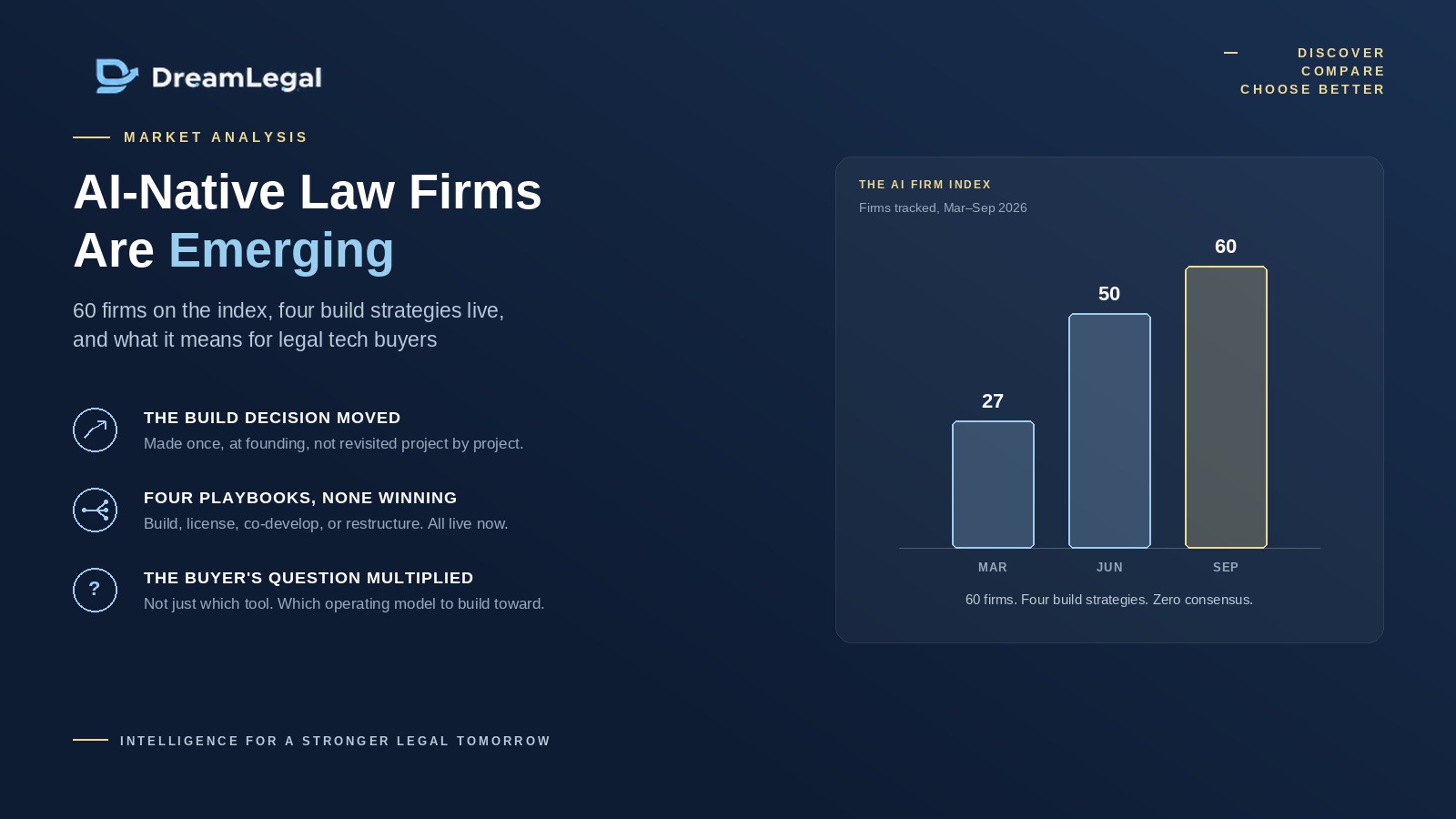
FairPlay Law launched on 16 September with a familiar pitch: flat fees, an AI-driven review of your offer letter or severance package, and a human lawyer at the end of it. Founded by Pangea3 alumni David Perla and Sanjay Kamlani, backed by an outside-capital managed-services organisation, it's the newest entry in a category that barely existed eighteen months ago. The AI Firm Index, a directory started as a weekend project by Lupl co-founder Matt Pollins, had 27 firms on it in March. By late June it had passed 50. It's now tracking around 60, while its own "what is an AI law firm" page admits the definition is still being written.
That admission matters more than it sounds. The interesting question isn't what these firms are. It's what their arrival says about how legal technology gets discovered, evaluated and bought.
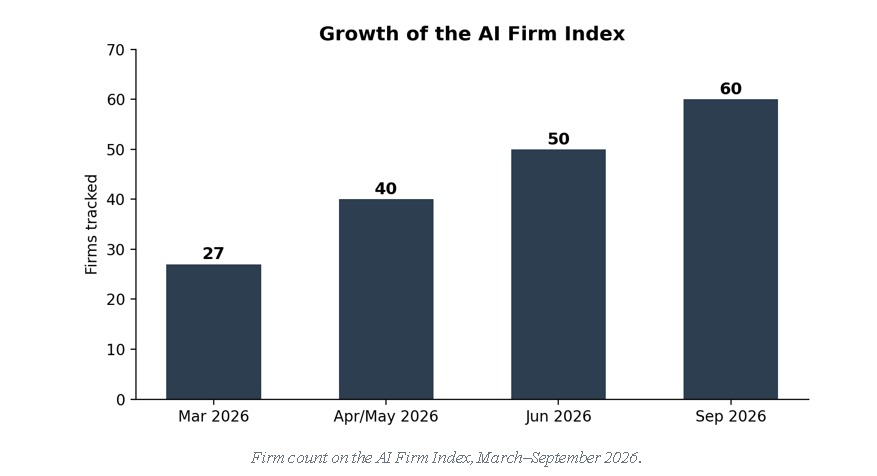
Firm count on the AI Firm Index, March–September 2026.
Sources: Artificial Lawyer; general.legal; aifirmindex.com; brief-provided count.
The pattern underneath the pitches
Line up FairPlay, General Legal, Soxton, Moritz, Vector Legal and Talairis and a few things repeat. Every one of them prices work as a flat fee rather than by the hour, and every one puts AI ahead of a lawyer in the workflow rather than beside one. Moritz says its software handles roughly 80% of a contract before a lawyer reviews the remaining fifth. General Legal's co-founder told Artificial Lawyer the firm is hitting close to a 40% margin on $500 flat-fee contract reviews, a number that only works if AI is doing the bulk of the drafting rather than sitting alongside a billable associate. Soxton runs AI-first drafting through roughly 40 contract attorneys and two engineers, charging $100–200 per document.
Where they diverge is in how the technology gets sourced. Moritz sits inside an MSO structure and draws its AI from an affiliated technology provider, Parlai, under a licensing arrangement forced by state bans on non-lawyer fee-sharing. General Legal and Vector Legal built their own platforms in-house — Vector's VectorOS, built by a former Ironclad engineer, or General Legal's tooling, built by former Casetext and Thomson Reuters engineers. Talairis describes a "four-layer architecture" with more than 100 purpose-built agents sitting on top of a foundation model. None of them are simply buying an off-the-shelf legal AI tool and bolting it onto an existing practice. The build decision is made once, at the firm's founding, rather than revisited project by project.
Firm | Pricing model | Where AI sits | Technology source |
FairPlay Law | Flat fee (employment matters) | AI analysis precedes lawyer engagement | Built by affiliated MSO, FairPlay Global |
General Legal | Flat fee ($250–$1,000 per contract) | AI drafts first pass; lawyer reviews | Built in-house (ex-Casetext/Thomson Reuters team) |
Soxton | Flat fee ($100–$200 per contract) | AI drafts; ~40 contract attorneys review | Built in-house |
Moritz | Flat fee, agreed upfront | AI does ~80% of drafting; lawyer reviews 20% | Licensed from affiliated tech provider, Parlai |
Vector Legal | Fixed fee or monthly retainer | AI drafts/redlines inside VectorOS; escalates to lawyer | Built in-house (VectorOS) |
Talairis Law Group | 10–15% of comparable Big Law fees | 100+ purpose-built agents draft; partners review | Built in-house, attorney-built agents |
A snapshot of six recent AI-native launches — patterns, not profiles.
Sources: Reuters/Law360 (FairPlay); general.legal pricing page; Artificial Lawyer interview with General Legal co-founder JP Mohler; Pulse2/BusinessWire (Soxton); Y Combinator, Sifted, Global Legal Post (Moritz); Dealroom, Vector Legal (Vector Legal); GeekWire, Zetik (Talairis).
Staffing follows the same logic. These firms hire senior lawyers, not junior associates. Talairis co-founder Sam Shaddox describes AI absorbing the work that would traditionally go to first- and second-year associates, while General Legal and Soxton both insist on Big Law-trained attorneys reviewing every AI output. Bloomberg Law reported that General Legal, Soxton and Talairis are actively recruiting mid-level associates frustrated with how slowly their current firms are adopting AI — a talent pull that established firms are starting to notice, even if the revenue pull isn't there yet.
What changes when AI sits at the centre, not the edge
A Law360 panel on AI-native firms this month put it plainly: these firms face a genuine tension between the efficiency of automation and their professional obligations, and the industry hasn't settled how to supervise AI-generated legal work at scale. That's the honest version of what the AI Native Law Conference calls experimentation across staffing, pricing, supervision, knowledge capture and delivery. The examples bear it out. Knowledge capture shows up as Talairis's "client genome," a persistent profile of a client's contracts, risk tolerance and history that the firm's agents draw on for every new matter. Delivery shows up as same-day or sub-hour turnaround, a service level that would be uneconomical without AI doing the first pass.
The buyer's problem gets harder, not easier
This is the part that matters for anyone buying legal technology, not just anyone starting a law firm. If a firm bolts a tool onto an existing workflow, the technology question is simple: which product solves this problem. If a firm redesigns the workflow around AI from day one, the question multiplies into several: what gets automated, what gets bought, what gets built, what has to integrate with what, where does a firm's own data and precedent live, where does human judgment stay non-negotiable, and how is all of it governed.
Thomson Reuters' 2026 Future of Professionals report puts a number on the gap this creates. Corporate legal departments increasingly want their outside counsel to show AI-driven value: 77% of clients said receiving AI-enabled quality improvements is very important or essential. Set against that, only 28% of law firms have actually changed their pricing structure in response to AI, even though 71% of in-house teams expect them to. Thomson Reuters estimates roughly $143 billion in client revenue is now under active reconsideration in the US alone, as clients weigh moving work to providers that can demonstrate AI value rather than just claim it. That's the pressure AI-native firms are pushing on established ones, whether or not they ever win a large share of the work themselves.
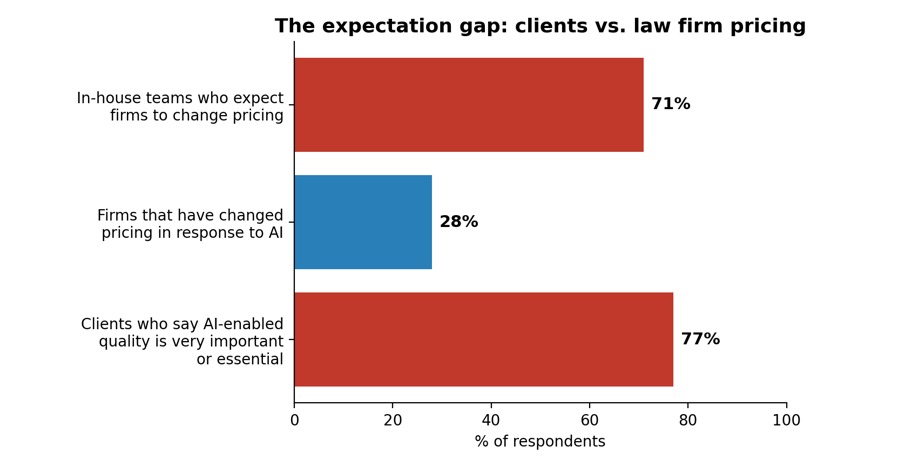
Client expectations are running well ahead of law firm pricing changes.
Source: Thomson Reuters, Future of Professionals Report 2026 (legal edition).
A market with several playbooks now, not one
Established firms aren't standing still, and they're not converging on a single response either. Kirkland & Ellis has committed $500 million to building a proprietary AI model. DLA Piper is weighing a mix of internal build and outside tools rather than picking one lane. Norm AI, which built compliance software for financial institutions, launched its own law firm, Norm Law, to compete directly with Big Law rather than just sell into it. Meanwhile Harvey and Legora, the two dominant AI platforms firms buy rather than build, have each raised hundreds of millions of dollars this year and are hiring former practising lawyers into "legal engineer" roles by the dozen to help firms actually run the tools they've licensed.
So a firm today can build its own AI, license a platform like Harvey or Legora and staff a legal-engineering team around it, co-develop technology with a vendor, or restructure entirely around an AI-native model from scratch. All four are live strategies in the market right now, and none of them is obviously winning.
Where that leaves the search for the right tool
The result is a more complicated job for legal teams. The question is no longer simply whether AI can solve a particular problem, but which approach makes sense for the way a particular organisation works, what it will take to implement it, and how it will perform once it becomes part of an actual workflow. With more approaches, vendors and implementation models entering the market, buyers now have to understand not only what is available, but how these options differ, what each one demands from the organisation, and where they are genuinely suited to a particular workflow. The decision is therefore becoming less about adopting AI as a category and more about continuously discovering, evaluating and testing what is actually useful.
This is where DreamLegal’s role becomes increasingly important. Rather than adding another product to an already crowded market, DreamLegal sits on the buyer side of it, giving legal teams a way to navigate this expanding landscape, understand the choices in front of them, and assess what actually fits the way they work.
Was this update helpful?
Continue reading
Related articles

Legal AI
Pillsbury Becomes First AmLaw 100 Firm to Deploy rubi's AI Mentor for Associate Training
Read article
Legal AI
Wordsmith and Goodlawyer Combine AI Platform With Fractional Counsel Network
Read article
Legal AI
LexisNexis Bets on Practitioner-Consultants to Drive AI Adoption at Large Law Firms
LexisNexis hired former practicing attorney Bennett Blachar as a Legal Engineer on its Large Law Knowledge Management & Innovation team, effective October 1, 2026, signaling a deliberate push to close the gap between AI capability and courtroom-ready implementation.
Read articleStay informed
Make your next legal technology decision with more clarity.
Join DreamLegal for independent research, market perspectives, and practical evaluation guidance for legal teams.
Create Free Account