LEGAL AI

Cyril Shroff AI Law Centre: India's First AI Governance Institute Launches Globally

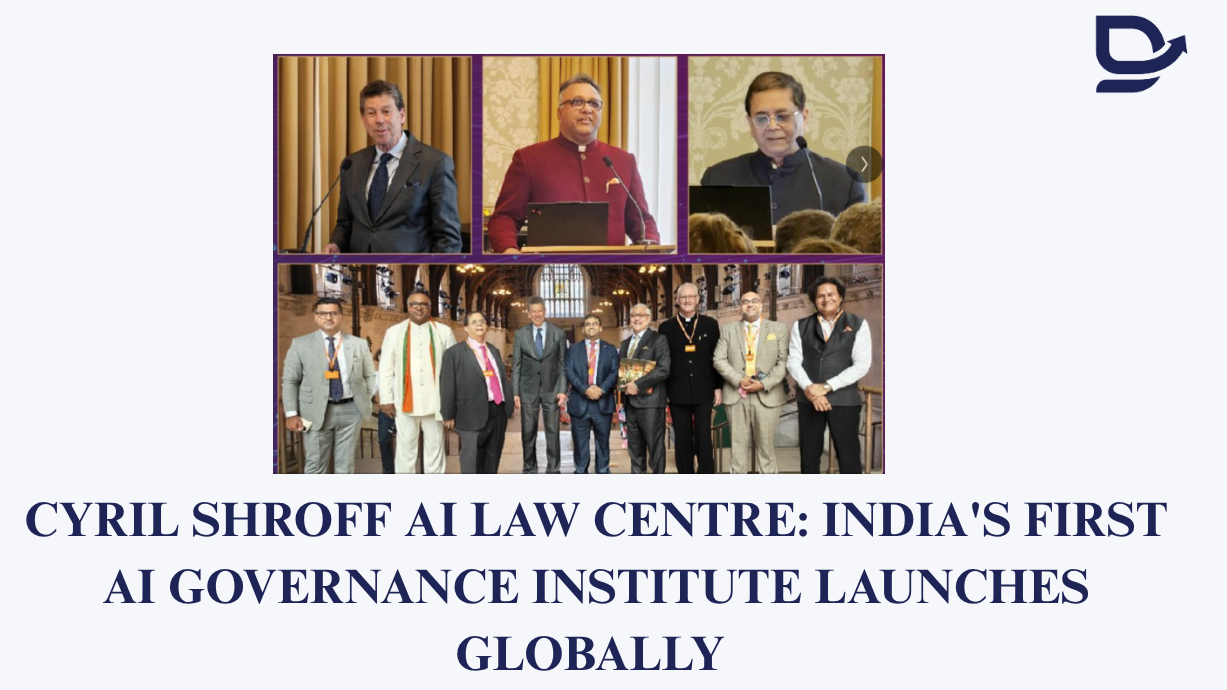
The Cyril Shroff Centre for Artificial Intelligence, Law and Regulation was formally launched at the Law Society of England and Wales, London, marking India's first dedicated institution for AI law an

2 July 2025 5 min readDreamLegal Research

Share article

Cyril Shroff AI Law Centre: India's First AI Governance Institute Launches Globally

The Cyril Shroff Centre for Artificial Intelligence, Law and Regulation was formally launched at the Law Society of England and Wales, London, marking India's first dedicated institution for AI law and policy. Established through a ₹15 crore endowment by Cyril Shroff, Managing Partner of Cyril Amarchand Mangaldas, the centre positions Jindal Global Law School as a pioneer in ethical AI governance from the Global South. Harvard Law School's Professor David B. Wilkins delivered the inaugural lecture on "Reimagining Law, Lawyers, and Justice in the Age of Artificial Intelligence."

Foundation and Global Expansion

The centre's journey began with its initial announcement in India on May 3, 2025, at Jindal Global Law School, where it was established as India's first dedicated Centre of Excellence focusing on the intersection of artificial intelligence, law, policy, and regulation. The subsequent London launch on July 1, 2025, represents the centre's global expansion strategy, leveraging the historic Law Society of England and Wales as a platform to influence international legal discourse and regulatory thinking.

Strategic Positioning: From Policy Follower to Global Leader

The centre's establishment reflects a paradigm shift in India's approach to technology governance. Rather than merely adopting frameworks developed elsewhere, the initiative positions India as an originator of AI regulatory thinking. Professor C. Raj Kumar emphasized this transformation, noting that "normative rule-making and benchmarking should not merely follow—but begin" from the Global South.

This strategic positioning addresses a critical gap in global AI governance, where developing economies have traditionally been consumers rather than creators of regulatory frameworks. The London launch venue itself signals intent to influence international legal discourse from a position of intellectual authority.

Interdisciplinary Innovation Framework

The centre operates on ten core objectives spanning research, policy formulation, curriculum development, and global engagement. These objectives create a comprehensive ecosystem addressing AI's intersection with law across multiple domains:

Research Infrastructure: Cutting-edge research on AI regulation, ethics, governance, and liability forms the foundation, with emphasis on producing policy recommendations for both Indian and international regulatory bodies.

Educational Innovation: Development of AI-integrated law courses and executive education programmes targets legal professionals, policymakers, and corporate leaders, addressing the skills gap in AI governance.

Global Engagement: Active collaboration with OECD, UN, WTO, EU, and G20 initiatives ensures Indian perspectives influence international AI governance discussions.

Addressing Contemporary Legal Challenges

The centre tackles emerging legal complexities that traditional jurisprudence struggles to address. Professor David Wilkins highlighted that AI is "transforming the very architecture of legal systems," requiring lawyers to become "architects of technological justice."

Key focus areas include AI accountability, product liability for autonomous systems, algorithmic bias in fundamental rights contexts, and the transformation of legal practice through AI-powered tools. The centre's approach to litigation and liability frameworks for AI-driven risks represents a proactive stance on issues that will define legal practice in the coming decade.

Financial Sector Integration

The centre's focus on AI and financial regulation addresses critical gaps in India's rapidly digitizing economy. With specific attention to banking, fintech, algorithmic trading, and risk management, the initiative recognizes finance as a primary domain where AI governance frameworks will be tested and refined.

This focus aligns with India's position as a global fintech hub, where regulatory clarity on AI applications could determine competitive advantage in digital financial services.

International Collaboration Network

The launch featured a distinguished panel including experts from University College London, Cambridge, Queen Mary University, Linklaters, White & Case, and former Supreme Court Justice Michael D. Wilson of Hawaii. This international composition demonstrates the centre's global reach and credibility.

The collaboration spans Indian agencies (NITI Aayog, Ministry of Electronics & IT, RBI, SEBI, TRAI), global regulators (OECD, EU AI Act institutions, US FTC, UK AI Safety Institute), leading universities (Harvard, Oxford, Stanford, MIT), and technology leaders (Microsoft, Google, OpenAI, Meta).

Implementation Roadmap

The centre's five-year strategic vision encompasses launching interdisciplinary research projects, developing AI ethics frameworks for India, hosting international AI law summits, and establishing chair professorships with research grants. This structured approach ensures sustained impact beyond initial launch momentum.

The initiative's timing coincides with India's historic decision to allow foreign law firms into the domestic legal sector and the anticipated Indo-UK Free Trade Agreement, creating synergies for cross-border legal and technological collaboration.

About the Organization

Cyril Amarchand Mangaldas operates as India's leading full-service law firm with 108 years of experience. The firm maintains national coverage through offices in Mumbai, New Delhi, Bangalore, Hyderabad, Ahmedabad, Chennai, and GIFT City, plus international presence in Singapore and Abu Dhabi, employing 1,200 lawyers.

O.P. Jindal Global University, founded by Naveen Jindal in memory of his father Shri O.P. Jindal, stands as a non-profit, research-intensive university recognized as an Institution of Eminence by the Government of India. Ranked the No. 1 Private University in India by QS World University Rankings 2025, JGU houses 12 schools, 6 institutes, and over 60 research centres, attracting students and faculty from 75+ countries.


Was this update helpful?

Sources

  1. 1
    Cyril Shroff AI Law Centre of Jindal Global Law School Launched in London by Harvard Law Professorhttps://www.ptinews.com/story/business/cyril-shroff-ai-law-centre-of-jindal-global-law-school-launched-in-london-by-harvard-law-professor/2689579
  2. 2
    Cyril Shroff AI Law Centre of Jindal Global Law School launched in Londonhttps://www.barandbench.com/Law-School/cyril-shroff-ai-law-centre-of-jindal-global-law-school-launched-in-london
  3. 3
    Cyril Shroff Centre For AI, Law & Regulation established at Jindal Global Law Schoolhttps://jgu.edu.in/cyril-shroff-centre-for-ai-law-regulation-established-at-jindal-global-law-school
  4. 4
    Cyril Shroff AI Law Centre Of Jindal Global Law School Launched In London With Inaugural Lecture By Harvard Law Professor David Wilkinshttps://www.livelaw.in/lawschool/news/cyril-shroff-ai-law-centre-jindal-global-law-school-david-wilkins-296201

Stay informed

Make your next legal technology decision with more clarity.

Join DreamLegal for independent research, market perspectives, and practical evaluation guidance for legal teams.

Create Free Account