UPDATE
DreamLegal In Conversation with Ayush Chandra Co-Founder, LegalTechPolicy.com
In this interview with DreamLegal, Mr. Ayush Chandra, co-founder of LegalTechPolicy.com, explains why legal functions turn into bottlenecks, why he wrote an implementation playbook before building any software, and why so many legal tech subscriptions go unused within months of purchase.
Share article
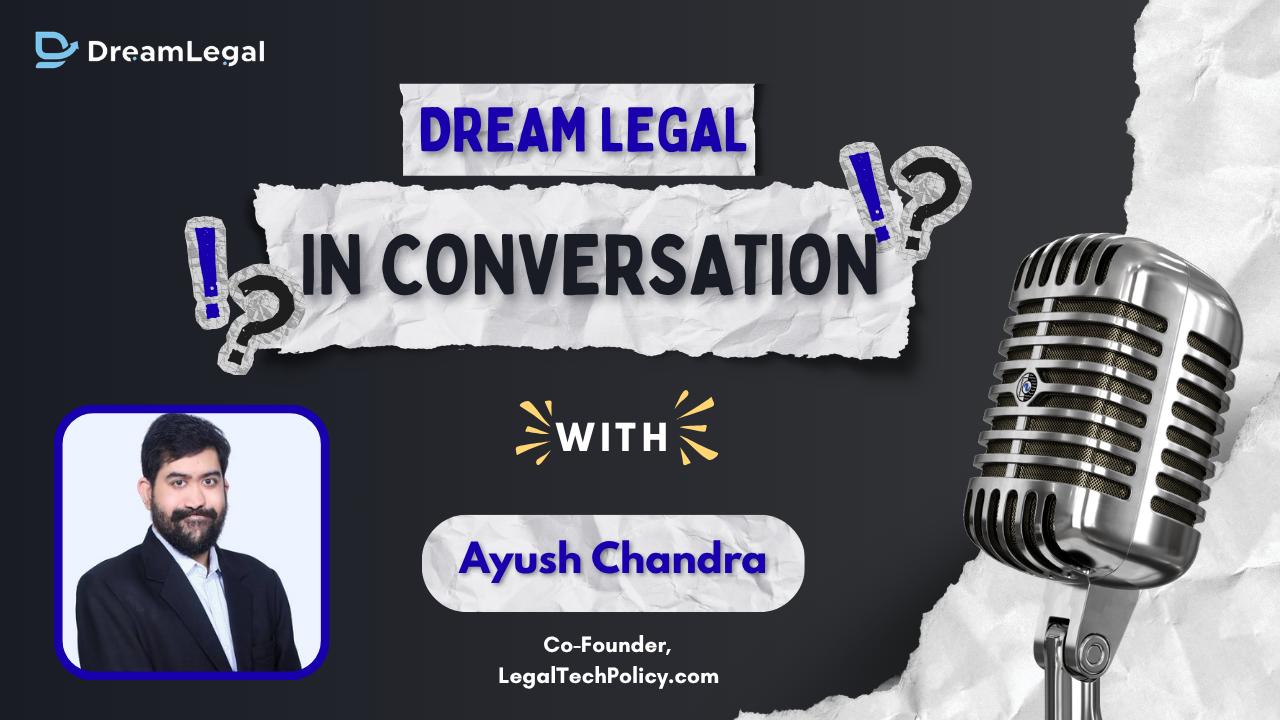
Mr. Ayush Chandra is Co-Founder of the LegalTechPolicy.com Playbook, built with Indic Pacific Legal Research and DreamLegal. A Mumbai-based lawyer and former in-house counsel, he was Legal and Compliance Officer at Group Avows from 2023 to 2025, covering India, Malaysia and Indonesia, after earlier roles in due diligence and contract management. He holds an LLM from NMIMS Mumbai and a Master’s in Business Law from NLSIU Bengaluru, with certifications in product management (Duke Corporate Education), digital marketing (MICA Ahmedabad) and cyber law (Asian School of Cyber Laws). The Playbook, which he wrote with Abhivardhan and Ranjan Singhania, sets out 80 operating principles for legal departments, in-house teams and startups. It was launched at the 7th Gujarat National Law University Legal Services Forum 2026 and covered by Bar & Bench.
Mr. Chandra begins with the moment he realised practising law alone wouldn’t fix the delays he kept meeting, and the structural problems he saw in in-house departments. He explains why the Playbook came before any software, why companies that buy legal tech first and think later end up with unused licences, and which unglamorous work should come before AI. He closes with advice for young lawyers who want to build a career in legal innovation.
DreamLegal: You began your career in legal and compliance roles, including contract work, due diligence and in-house advisory. At what point did you realise that practising law alone was not enough—that you wanted to work on improving the systems through which legal work is delivered?
Ayush Chandra: Yes, my career began in legal and compliance role. Early on, I noticed something uncomfortable: I was spending good hours on work that a good system could have done in minutes, and I was contributing to the very inefficiency I wanted to solve. Bottlenecks in legal processes were the norm, not the exception. That was my turning point. I understood that legal teams do their best work when they are supported by systems that are properly built and maintained, freeing them to focus on strategic advice and are correct for their requirement. Building legal workflows became my way of protecting that value, so that lawyers are never get caught off guard and can bring their full skill to the work that matters.
DreamLegal: Your in-house role involved supporting business teams across India, Malaysia and Indonesia, while handling contracts, compliance processes and stakeholder expectations. What recurring problems did you see in the way legal departments operate that later shaped your interest in legal operations and legal technology?
Ayush Chandra: In-house legal departments consistently encounter structural challenges. Turnaround expectations are frequently misaligned with the complexity of the work, stakeholder interpretations of requirements vary widely, and business imperatives tend to dominate legal considerations. Counsels are burdened with repetitive manual tasks, and sales teams often provide delayed or incomplete inputs. Resource constraints and accelerated timelines leave legal teams underprepared, while the absence of standardized processes and supporting systems exacerbates operational inefficiencies. These conditions are inherent to in-house counsel roles and they must adapt to them while functioning in a persistently high-pressure setting along with solving them to bring ease in legal ops.
DreamLegal: For readers encountering it for the first time, what is LegalTechPolicy.com? What problem did you, Abhivardhan and Ranjan Singhania set out to solve when you began building it?
Ayush Chandra: LegalTechPolicy.com is a playbook that provides a structured framework for law firms, startups, corporates, and individuals seeking to adopt legal technology effectively. It sets out the principles on which adoption and implementation can be built, helping organisations avoid costly missteps and sustain their momentum over time. The playbook draws on three complementary perspectives: in-house legal and compliance experience, which exposed gaps in processes and systems; implementation and adoption experience, gained by working with companies to assess their needs; and consulting experience in AI and technology law, advising clients on separating hype from workable implementation. Together, these inform 80 governing principles that address the core issues common to every business.
DreamLegal: LegalTechPolicy.com did not begin as a software product; it took the form of an implementation playbook. Why did you choose to start with operating principles and practical frameworks rather than build another legal-tech tool?
Ayush Chandra: This is a question many people have asked us, and our view has remained consistent. Instead of building a product, we felt it was far more valuable to express this idea through a structured framework that anyone can read, revisit, and share. A product would come with limitations, dependencies, and the constant burden of development, whereas a framework can evolve freely and serve as a lifelong reference.
The Playbook offers that flexibility. It can be used by readers across law firms, startups, and corporate teams as a ready reckoner. Our intention was to first build a strong foundation, create awareness, and share a mindset rather than rush into tool-building. Policy thinking often solves problems at their roots, while product development tends to address symptoms.
Operating principles act as the starting point. Once people understand the problem clearly, they can begin to fix it. Jumping straight to solutions without understanding the underlying issues rarely leads to meaningful outcomes. Just as no one becomes a master without learning the fundamentals, no one should build a solution without understanding the problem and its technical realities. Wisdom precedes tools, and that is the philosophy behind the Playbook.
DreamLegal: You have worked closely with contracts, compliance and business teams. In your view, what is the first sign that a legal function has become a bottleneck for the business—and what is the most practical first step a company can take to change that?
Ayush Chandra: I’ve seen this pattern many times. The tension starts the moment Legal highlights a risk. Legal is protecting the company by assessing exposure, conducting due diligence, and redlining terms that could cause real harm later. But the business, under pressure to close deals and hit targets, hears something different. It hears “slowdown,” and it quickly labels Legal as a blocker rather than a partner. Over time, that label hardens into distrust, and each side starts to protect its own position instead of the company’s.
My approach would be to create a shared space where both teams can explain their reasoning openly. Legal can translate risks into business impact, quantifying what is at stake and proposing workable alternatives instead of simply saying no. The business, in turn, can outline its deadlines, revenue goals, and client expectations early, so Legal can prioritize its review and plan accordingly. Once both sides understand the context behind each other’s decisions, the “us versus them” mindset dissolves. Collaboration improves, trust builds, and deals progress without unnecessary friction.
DreamLegal: Founders often speak about the final product, but the more useful story is usually in the difficult middle. What was the hardest part of turning the idea into a finished playbook: defining the audience, agreeing on the framework, testing whether it was practical, or getting the right collaborators on board?
Ayush Chandra: In the beginning, our biggest challenge was not writing but choosing what to leave behind. We wanted to focus only on the principles that truly mattered and would help businesses the most. Each idea was evaluated carefully so readers wouldn’t feel buried under too much information.
Once we narrowed the list to a set of practical, business-oriented principles, the structure came together smoothly. The next challenge was finding collaborators, but the right people stepped forward. Their insights shaped the final book and reminded us that diverse voices make any framework stronger.
Now we move into the next chapter. We are inviting startups, companies, and practitioners to share real-world use cases, and we will soon introduce certification modules to build a strong community of legal tech advocates. The testimonials and forewords we received have been a source of constant encouragement.
DreamLegal: You bring legal training together with product management, cyber law, digital marketing and business-law education. How has that combination affected the way you build? Can you share one instance where thinking like a product manager, rather than only as a lawyer, changed your approach to a legal problem?
Ayush Chandra: My combined training forces me to approach problems differently. I always begin with the objective, the user, and the “how” and “why” before touching the legal detail.
A practical example came during the Playbook build. The lawyer in me wanted to expand the content with more obligations and principles. But the product manager in me stepped in and said: “This is an MVP. Don’t complicate it.” That shift helped me focus on business‑legal outcomes first and reserve the deeper legal obligations for the next phase, once user case studies validated what truly mattered.
The two roles often conflict, but they eventually complement each other. The lawyer ensures compliance; the product manager ensures usability. Together, they create a balanced, practical structure.
DreamLegal: Many organisations buy legal-tech tools but struggle to make them part of daily work. From your experience, what separates a successful legal-tech adoption exercise from one that becomes an unused subscription after a few months?
Ayush Chandra: You’ve touched the heart of the issue. The tool is almost never the real problem. The real problem is that companies buy first and think later. The effective approach is cross-functional alignment. Bring legal, IT, finance and business teams together. Identify the bottleneck, assess whether technology is needed, and quantify the cost of inaction. Fix a budget, allow flexibility, and conduct proper due diligence. When vendors present, evaluate them against your requirements and their security and privacy frameworks, not the appeal of a demo.
And signing the contract is only the beginning. Six months later, ask whether work is faster, whether adoption is real, whether ROI is visible, and whether the vendor responds when things break. That is what determines renewal. During the AI wave, many companies ignored all of this. FOMO drove decisions, and licences ended up unused.
DreamLegal: India’s legal sector is now seeing intense interest in AI, contract automation and legal operations. Where do you think founders and legal teams are getting carried away, and which less glamorous problems should they solve first before adopting more advanced technology?
Ayush Chandra: The industry is seeing an intense and overwhelming flow of legal tech tools, pushed forward by the AI wave. This has created a “now or never” pressure to adopt legal tech. With AI, contract automation and legal ops platforms everywhere, founders and legal teams are getting carried away by AI‑enabled capabilities, fancy demos, market hype and glittery promises. Many start treating legal tech as the next fad and assume these tools will become their lifesaver. That assumption is completely misplaced.
The fundamental issue is that internal processes and structural problems lose priority. Founders and legal teams forget to examine their intake systems, operational gaps and workflow discipline. They expect tools to act like superheroes who will fix everything. But the non‑glamorous work is what actually matters. Companies need to validate intake quality, investigate operational issues, build mechanisms for pushbacks, design minimalist workflows and get their house in order before expecting legal tech to magically transform their department.
Legal tech is not Harry Potter. It will not use wizardry or cast a spell to make your company run smoothly. Unless structural fixes and mindset changes take precedence, no miracle will happen. The right approach is to fix your issues, understand where you genuinely need support and then explore technology. Otherwise, you create more problems and simply jump onto the AI hype wave. Introspect before taking a free‑fall jump.
DreamLegal: For a young lawyer or law student who wants to move beyond conventional practice and contribute to legal innovation, what would you advise them to do in the next 12 months? Which skills, experiences or habits genuinely build credibility in this space?
Ayush Chandra: To every young lawyer and law student exploring legal innovation, I want to share a clear message. Legal tech is not a fallback when litigation or corporate roles don’t work out. If you treat it as a convenient substitute, you are approaching it incorrectly. This field needs people who genuinely care about building, solving and creating value.
Go back to your drawing board. Ask yourself what you want to achieve. Think about the roles you want to work in, the skills you want to learn and the problems you want to solve. Once you find your answer, start building your skill set. Over the next six to twelve months, begin researching courses, attend events, join hackathons and participate in workshops that strengthen your foundation.
Introspection is essential. Understand your strengths and weaknesses. Grow slowly and consistently. No one becomes exceptional in a day, not even your favourite players or idols. Everyone has their own journey and story. Excellence comes from perseverance. Seek mentors, understand their perspective, intern with legal tech or AI companies and learn the basics of product building and innovation.
If legal tech excites you, start watching product showcases. Observe how products are built, how user flows are designed and how real problems are solved. This will give you clarity and purpose. And if you ever want guidance, I am always open to conversations with young lawyers and students who want to build a career in legal tech.
This Interview was conducted and edited by the DreamLegal team.
Was this update helpful?
Stay informed
Make your next legal technology decision with more clarity.
Join DreamLegal for independent research, market perspectives, and practical evaluation guidance for legal teams.
Create Free Account