LEGAL OPS ANALYTICS
DreamLegal: In Conversation with Mr. Ankit Kumar
In this interview of the Dream Legal podcast, the hosts speak with Mr. Ankit Kumar, who manages legal tech marketing in India for LexisNexis, on what makes marketing to the legal fraternity different from every other industry, the maturity of India's legal tech market, and why product, not networking, is what ultimately wins trust with lawyers and law firms.
Share article
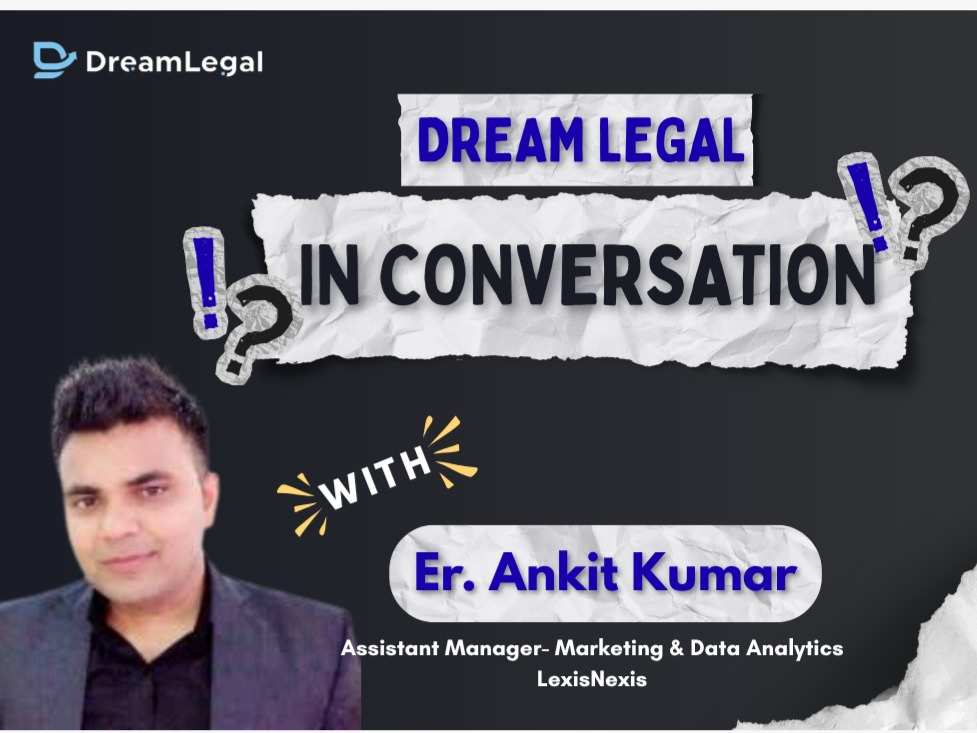
Mr. Ankit Kumar is Assistant Manager, Marketing and Data Analytics at LexisNexis, with over twelve years of experience across FMCG, HR tech, BFSI, and industrial sectors. He specialises in demand generation, go-to-market strategy, and data-driven marketing, and has led legal tech marketing initiatives for LexisNexis in India.
Mr. Ankit Kumar opens by explaining why marketing to the legal fraternity cannot follow the same playbook as B2C or other B2B industries, given the restrictions on lawyer advertising, the risk of being sued for inaccurate content, and the limited windows of availability of legal professionals who spend much of their day in court. He then discusses the maturity of India's legal tech market relative to the US and UK, the lesson that took him longest to learn across a twelve-year marketing career, who is actually buying legal tech in India today, and why LexisNexis' own legacy database sets it apart from competitors sourcing content externally. The conversation closes with his view that in legal tech, the product itself, not networking or relationships, is what ultimately builds trust with lawyers and law firms, and a note on how he tracks whether marketing efforts are working.
DreamLegal: Welcome, Ankit. You have worked across FMCG, HR tech, and BFSI, and now legal tech. What is actually different about marketing in the legal industry?
Ankit Kumar: Legal professionals cannot be marketed to the way other industries are. We cannot take their names or tag them without prior permission. It's a very niche market, and strategies that work elsewhere, bulk emailing, heavy social media advertising, the kind of approach a B2C brand like Zepto or Flipkart would use, simply do not work here. Whatever we say to a legal professional, and whatever product we showcase, has to be authentic. If the product does not fit well, or if we give wrong information, this industry can sue us for it. On top of that, lawyers are largely unavailable for most of the day since they are in court, so we typically reach them only in the second half of the day.
DreamLegal: How mature is India's legal tech market compared to the US or UK?
Ankit Kumar: India is still growing in AI and tech adoption for legal business. It's a price sensitive market, with a large number of states and cultural and linguistic differences to account for. Our youth is more open to new technology, and tools like ChatGPT, Gemini, and Claude are being explored widely, but a lot of that use is still without checking the facts first. That's something the market needs to manage better. I'd say India is still a beginner in this space, but in the next three to four years we can become a serious player if we manage the transition right.
DreamLegal: What's one lesson from your twelve-plus years in marketing that took you the longest to learn?
Ankit Kumar: You cannot apply the same channels and strategies to every industry, and even within one industry, the channels keep changing. Email and SMS marketing were relevant five or six years ago; people barely check SMS today. Facebook used to be where audiences were; now it's shifted to Instagram and LinkedIn, particularly for Gen Z or legal professionals. Events have moved from social gatherings to business focused legal events. The bigger shift is that companies need to become customer centric rather than building a product first and pushing it into the market. Reliance Jio is a good example, they changed the market by giving customers more data and changing consumer behaviour entirely. Nokia was a market leader with a large share, but because they didn't evolve their product, they were overtaken by Micromax, and later by Samsung and Apple. You have to keep changing with the environment, or the environment will change you.
DreamLegal: Who is actually buying legal tech in India right now, law firms, in-house legal teams, or individual lawyers, and does that change how you market to them?
Ankit Kumar: Lawyers and senior advocates used to carry large volumes of books and material into court. Legal tech companies have brought judgments, bare acts, and secondary content onto a single platform. LexisNexis has products like Protege and Lexis Advance that are trusted by a large number of lawyers and authors. We carry a legacy of around 135 years of published journals, including the Madras Law Journal and Labour Law Journals. That legacy, combined with premium authors we've worked with such as Mulla, Ramaiya, Justice Nariman, and Nani Palkhivala, isn't easy to replicate. There's a lot of investment happening in this space now, with companies like Harvey entering and tying up with existing players in India. The company that wins in this space is the one that puts the right content in front of the right people, and that starts with being product centric, not just customer centric.
DreamLegal: Beyond legacy and awareness, are there cost or trust issues slowing down legal tech adoption in India?
Ankit Kumar: I wouldn't say India isn't tech savvy. Compared to the US and UK, we're still catching up in certain areas of deep technology, the way we're behind in areas like fighter jet engines compared to the US or Russia. But in software engineers, testers, and developers, we're not far behind. Legal technology is hard to build because the nuance of law depends heavily on circumstance, the same act can be a crime or self-defence depending on context, and that nuance is difficult to encode. What sets LexisNexis apart is that our database is owned by us. Other companies often source data from third parties that may or may not be reliable. Every case and judgment we put on our platform is checked by developers, content writers, lawyers, and authors before it goes live.
DreamLegal: This industry runs heavily on personal relationships and referrals. How do you build genuine trust with lawyers and law firms without coming across as just another vendor?
Ankit Kumar: The product has to be the hero. When people hear that I represent LexisNexis, they take the meeting more seriously because of the trust the company has built over time. But networking only works when the product itself can stand on its own. Sahara was a large company with strong networking and capital, but their product wasn't right, and they collapsed. Nokia had scale and market share but didn't evolve its product, and eventually vanished from the market to Samsung, Apple, and OnePlus. You can spend a large marketing budget and get a customer to buy once, but without a strong product, you won't get repeat business. Build the product first. Networking and relationships matter, but only alongside a product people actually want.
DreamLegal: So what has actually worked for you to reach lawyers and law firms, LinkedIn, events, referrals, or content?
Ankit Kumar: It's never been just one channel. Our legacy as a company operating for over a hundred years brings us referrals through word of mouth. We get prospects through our website, we're active on LinkedIn with updates on what we're working on, and we maintain our email and other digital channels. Events matter too. But all of these channels only work if the product itself is strong. You can spend a large amount on marketing, but if the product isn't ready to be purchased, people won't buy it, and if they do buy once, they won't come back.
DreamLegal: When do you actually know if a marketing effort is paying off? What numbers do you track first?
Ankit Kumar: We track it through our website, through how many customers are renewing, and through footfall and engagement at our events. Traction on our posts and across our channels is a key parameter. If a visitor comes to our website and bounces without exploring the products or reaching the contact page, that's a wasted visit and a sign the strategy isn't working. For webinars, we track how many people registered against how many actually attended, and for how long. Those are the parameters that tell us whether the strategy or the product is genuinely working.
DreamLegal: What's a common myth about legal tech marketing that you'd like to bust?
Ankit Kumar: People often think legal tech marketing is basic or traditional, that you can enter this market and generate revenue the way you would in any other industry. It's a very niche market. You're not selling a product where a misprint or unreliable content can be brushed aside, this is a fraternity that can sue you without hesitation. Building a legal tech product isn't the hardest part, building the relationship and the trust around a genuinely reliable product is. These are highly experienced professionals, and they cannot be treated like an ordinary customer base.
This podcast was conducted and edited by the DreamLegal team.
Was this update helpful?
Continue reading
Related articles
Legal Ops Analytics
Latitude Legal Names Alex Su President as Flexible Counsel Demand Accelerates
Read article
Legal Ops Analytics
Lawfront Adds Two Regional Firms as Technology-Backed Consolidation Reaches 18 Deals
Read article
Legal Ops Analytics
GCVC Emerges From Stealth With 50-Plus General Counsels Backing Legal Tech
Read articleStay informed
Make your next legal technology decision with more clarity.
Join DreamLegal for independent research, market perspectives, and practical evaluation guidance for legal teams.
Create Free Account