LEGAL AI

DreamLegal: In Conversation with Mr. Pintu Babu

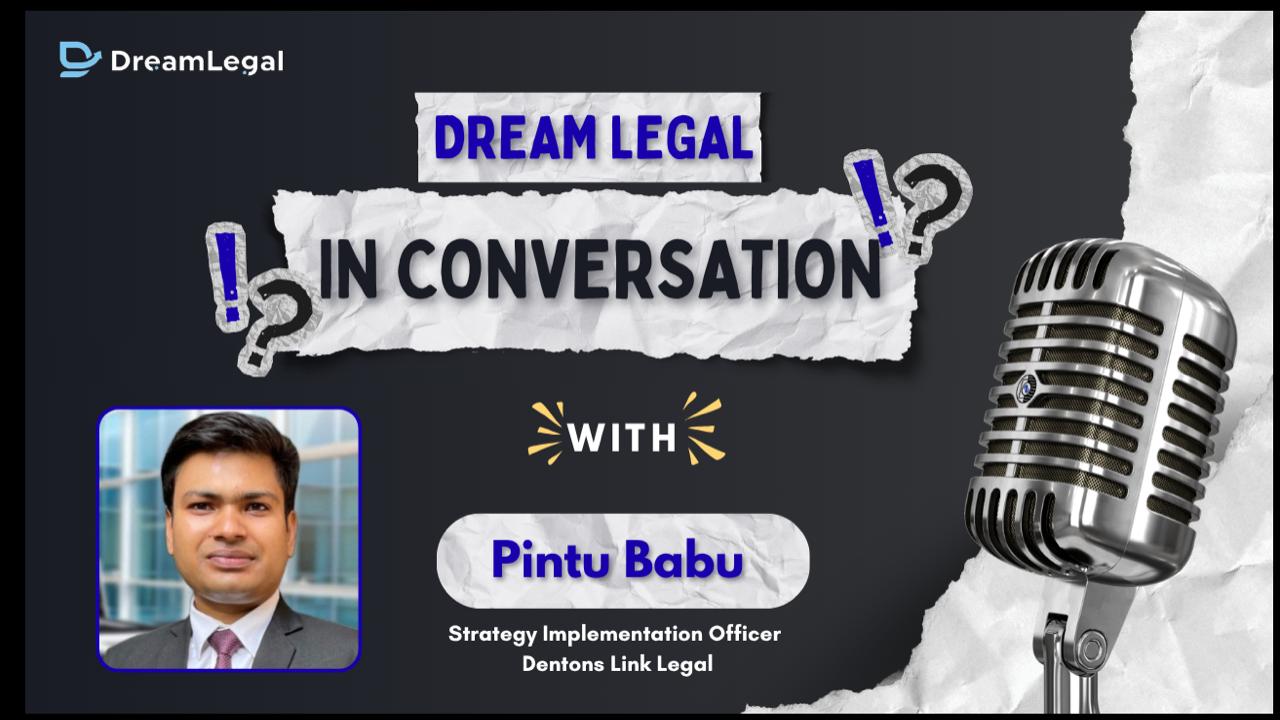
In this DreamLegal interview, the hosts speak with Mr. Pintu Babu, Strategy Implementation Officer at Dentons Link Legal. He shares his perspective on his transition from law to LegalTech, the business and strategy side of law, how firms evaluate and adopt legal technology, and the impact of AI on the legal profession.

8 September 2026 10 min readDreamLegal Research

Share article

DreamLegal: In Conversation with Mr. Pintu Babu

Mr. Pintu Babu is currently working as Strategy Implementation Officer at Dentons Link Legal, where he focuses on strategic initiatives spanning business growth, operational excellence, LegalTech, practice automation, marketing, and firm-wide collaboration. Prior to joining Dentons Link Legal, he was part of the Practice Development Team at Nishith Desai Associates, working across strategic growth, marketing, corporate communications, data analytics and knowledge management. Earlier, at PSL Advocates & Solicitors, he developed a case management software and contributed to the firm’s operations through technology-driven solutions.

His work sits at the intersection of law, technology, business development and strategic implementation within professional services organisations.

DreamLegal: Most people who pursue a law degree picture themselves either in litigation or corporate law. What exactly drew you towards strategy and business development instead?

Pintu Babu: Thank you, Dream Legal team for organising this interview series and for inviting me to participate. Most law students, after law school, would choose either litigation or the corporate practice of law. I opted for a non-conventional route, focusing on the LegalTech and business side of law. I remember, when I interned at law firms, I was able to observe the law firm ecosystem as a whole. I use this term intentionally, because there are dozens of moving parts in a law firm that are different from what is visible from outside. These include branding, client relationships, talent management, knowledge management and law firm strategy. This is what drew me to this side of law firm management.

Two things run in parallel in a law firm: the practice of law and the business of law. The practice of law is what most of us are trained for through five years of law school, the bare acts, the internships in courts. The business side, which we rarely learn formally, is what sits behind law firm management. This may cover how a law firm grows from ten lawyers to a hundred, how it enters a new market, and how it leverages technology in its operations.

Another reason I explored this journey was the year I graduated, 2020, the year of the COVID pandemic. The pandemic accelerated digital adoption, remote working, online collaboration and the use of legal technology in law firms, which also gave rise to more specialised functions within law firms such as practice management and legal operations.

Ultimately, my interest lies in solving organizational problems, whether legal, operational, technological or strategic. That is what I find fulfilling, and that is why I continue doing what I do.

DreamLegal: Your first roles out of law school were at PSL Advocates and Solicitors and later at Nishith Desai Associates, and both were in the founder's office. Can you tell us about your responsibilities there, particularly your work in legal technology and innovation?

Pintu Babu: People who work on the business side of a law firm usually work closely with the leadership team, including managing partners and senior partners. That gives you a different perspective of the firm which is not limited to a single practice area or sector. You begin to see the firm more as a managing partner does – across people, clients, operations, technology and growth - even though you are still relatively junior.

I remember, at my first job, working with the leadership team, I undertook the development of a case-management system. Before building it, I had to understand why the firm needed such a tool in the first place. A law firm’s past work and credentials are often useful for pitching prospective clients, but that data sits scattered across emails, spreadsheets, calendar invites and Word files. That fragmentation was the problem we were trying to solve, and it ultimately led us to build a case-management system.

Technology is rarely about software alone, it is about processes, people and how they align. Hence, legal technology should not be built around what developers find interesting, but around what lawyers find useful in their day-to-day practice.

Besides technology, one of the most commonly used terms in legal practice is ‘innovation’. Innovation is often confused with technology. But innovation in a law firm does not necessarily mean building sophisticated software. It can be improving existing workflows, reducing friction between two practice groups or sectors, improving internal knowledge sharing, or helping lawyers spend more time on legal work and less on administrative work.

DreamLegal: What were the biggest operational and business challenges that law firms face today that technology can actually help address?

Pintu Babu: At a macro level, I would put these challenges into three buckets: knowledge fragmentation, operational efficiency, and data-driven decision making.

On knowledge fragmentation, lawyers build intellectual capital from the day they enter the profession, through research notes, drafts, transaction experience and institutional knowledge, and that resource base keeps growing every year. In India, however, this information is often scattered, some of it sits in WhatsApp message exchanges, some in PDF or Word files, some in SharePoint folders, all in different formats. When a client wants to test whether a firm has relevant experience, this fragmentation becomes the biggest obstacle.

On operational efficiency, the picture is uneven. Even though the Indian legal market has matured, the majority of law firms still lack dedicated teams for matter management, document organization, client communication, workflow coordination, and other administrative processes that support the delivery of legal services.

On business intelligence and data driven decision making, consulting firms are far ahead because their decisions rely heavily on data. For a law firm, this could mean understanding which practice areas are growing, which sectors are generating demand, which clients may require deeper engagement, where referral opportunities are emerging, and what return the firm is getting from its business-development efforts.

If Indian law firms make meaningful progress across these three areas, there is significant scope to improve both operational efficiency and strategic decision-making.

DreamLegal: When you are evaluating a new technology solution for the firm, what does that process look like? Who are the key stakeholders involved, what factors make a tool compelling, and what are the common deal breakers?

Pintu Babu: Whenever I speak with a LegalTech vendor, I start with one question: what is the problem we are trying to solve? There has to be a problem worth investing time, energy and resources into, one that is solvable. Every vendor today talks about AI, automation, ML, predictive intelligence and digital transformation, but a template that works for another sector may not work for a law firm. The first step is identifying a specific problem for the firm.

The stakeholders depend on the solution being evaluated, but they typically include partners, associates who test the tool from a legal-efficiency perspective, knowledge-management teams, IT teams that assess cybersecurity and data requirements, and firm leadership, particularly where wider organisational buy-in is required.

Lawyers do not wake up excited to use software. They get excited about solving a client’s problem. If technology helps with that, the lawyer will adopt it. If it does not, the technology will not find good use in the long run. Firms also look for identifiable near-term benefits: time saved, improved client and lawyer experience, better reporting formats, and better internal collaboration.

A common deal breaker is that vendors are often not able to clearly articulate implementation requirements. By the time a firm reaches the implementation phase, the vendor may discover that the firm lacks the necessary integration systems, required resources or data sets, and deployment gets delayed. Vendors need to be specific about what deployment requires, including behavioral changes, training and workflow changes.

It is worth recognising that LegalTech vendors sometimes try to get a lawyer to identify a problem that the vendor can solve. However, manufacturing a problem to fit a vendor into the firm’s ecosystem is a reverse approach. Both sides need to identify the real problem together and then work on a solution for the lawyer and the client.

DreamLegal: One of the questions we usually get is about the AI proficiency of law firms and whether it will impact client preferences. Will a firm’s AI proficiency and capability decide who gets business?

Pintu Babu: I think AI, which is a platform shift, needs to be looked at slightly differently. If we look back at the history of technology, electricity and internet, both have fundamentally changed the way we live and how businesses are. AI has the potential to be similar.

So, I don’t think the right question is whether a client will choose law firm A because it has AI and reject firm B because it doesn’t. The more important question is what the firm is able to do differently because of AI.

If AI allows a firm to research faster, analyse larger volumes of information, identify issues earlier, improve the quality and consistency of drafting, manage knowledge better, or deliver a matter more efficiently, then ultimately that creates value for the client. And clients will notice that value.

So yes, AI capability will increasingly influence client preferences, but I don’t think it will be a standalone selection criterion. It will become part of the baseline capability expected from a modern professional services firm, including law firms.

And I think this is where the legal profession needs to be careful about the narrative around AI. The future is not necessarily about AI replacing lawyers. The legal profession has always adapted when technology changed the way legal work was done. We moved from print books to digital databases, platforms such as SCC Online and Manupatra reduced the time required to find precedents. These productivity gains did not necessarily happen the day the technology arrived. They came when organisations redesigned their processes around the technology. The same thing is likely to happen with AI.

DreamLegal: With India opening its legal market to foreign law firms, do you think Indian firms are underprepared from a legal technology perspective, or are the real challenges elsewhere?

Pintu Babu: The entry of foreign law firms is a recent development, about three years old. The immediate assumption is that foreign firms are ahead of us on technology, with bigger budgets and better systems, but the Indian legal market has evolved significantly over the last decade. Indian firms have a good level of acceptance and deployment of legal technology, cybersecurity, practice management software, client relationship platforms and, more recently, AI related solutions.

The biggest differentiator that is yet to be addressed is the institutional framework. Law firms are made up of partners tied to specific practice areas and sectors, and these partners often work in silos with their own teams and clients. When a partner leaves, years of knowledge built with the firm often leave with them. Indian law firms need systems where a firm does not rely only on individual partners.

There is also a growing focus on newer sectors in India, such as sports law, ESG or digital assets, which were not active practice areas about ten years ago. There is a long way to go, but the Indian legal market is gradually keeping pace with foreign players, and the entry of foreign law firms has made that process faster.

DreamLegal: For a young lawyer interested in legal technology and business development but unsure where to begin, what would be your advice for getting started?

Pintu Babu: The best advice I received from one of my seniors, and the one I would give, is to start by developing curiosity beyond the law. Move beyond the books, and try to understand how law helps a business grow or solve problems for a client. There was a time when a client remembered a lawyer only for litigation or drafting, but over time, lawyers have also become business enablers, and that is a mindset every lawyer in this ecosystem has to learn.

Along with this, law students and anyone interested in law firm management should value data literacy. Professional services and consulting firms are already adept at this, their decisions and strategies revolve around data, and this will gradually come to the legal sector as well.

This podcast was conducted and edited by the Dream Legal team.

Was this update helpful?

Stay informed

Make your next legal technology decision with more clarity.

Join DreamLegal for independent research, market perspectives, and practical evaluation guidance for legal teams.

Create Free Account