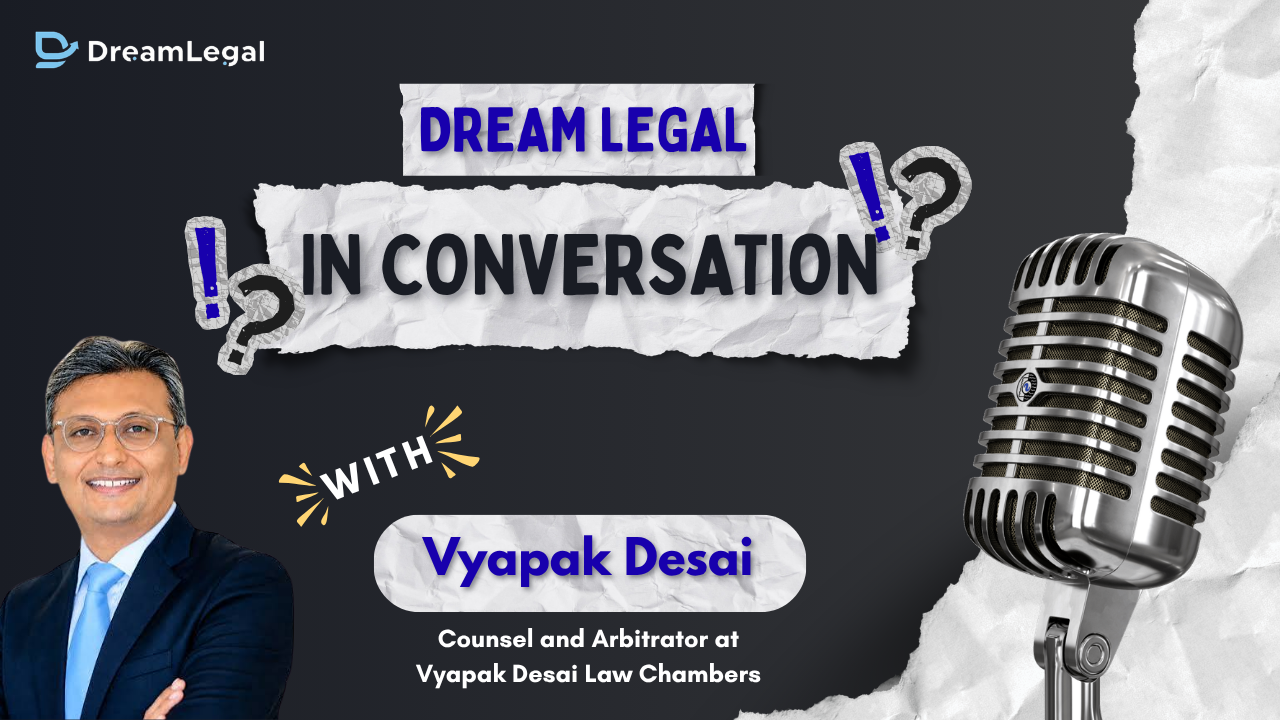
DreamLegal: In Conversation with Mr Vyapak Desai, Counsel & Arbitrator at Vyapak Desai Law Associates
In this interview, DreamLegal speaks with Mr. Vyapak Desai, who has practised across Indian and international arbitration for over two decades, starting at Nishith Desai Associates and now Independent Counsel at Vyapak Desai Law Chambers, and who is an Associate Member at 4 Pump Court, London.
Summary: In this interview, DreamLegal speaks with Mr. Vyapak Desai, who has practised across Indian and international arbitration for over two decades, starting at Nishith Desai Associates and now Independent Counsel at Vyapak Desai Law Chambers, and who is an Associate Member at 4 Pump Court, London. He has also held institution-building roles, including President of the Arbitration Bar of India and Director at the CIArb India Branch. The conversation covers his journey into arbitration, white collar and regulatory work, institution building through CIArb, confidentiality around legal AI tools, how technology is shaping the work of junior lawyers, what it will take for India to become an arbitration hub, and why adopting technology is non-negotiable for any modern legal practice.
DreamLegal: To begin, what made you choose arbitration at a time when most lawyers were heading straight into corporate practice or litigation?
Vyapak Desai: Unlike lawyers today, when I began, the profession wasn’t as structured; people didn’t choose early on whether they’d do transactions, litigation or arbitration, the way they can now, because information wasn’t as available and the legal industry hadn’t developed as rapidly. It wasn’t a conscious decision for me to become an arbitration lawyer; it happened naturally. I started as a litigator in the Gujarat High Court, then moved to Bombay after three or four years, and got into the corporate world quite early, a mix of litigation and corporate understanding that was fairly unique at that time. Corporations had contracts leading to arbitrations, so this blend was useful. Arbitration also has its own uniqueness: formal enough to be litigation, but informal enough to meet the commercial objectives parties actually go into disputes for, rather than getting swayed by procedure. So it was a combination of factors, and I was at the right place at the right time.
DreamLegal: Along with arbitration, you also handle white-collar and regulatory matters. How do you switch between the two?
Vyapak Desai: It’s never one factor but a series of factors leading to another. On one end, the corporate world looks for growth and ways to navigate a complex regulatory landscape; on the other, dispute resolution mechanisms help them get there. Arbitration stems from an agreement between two parties; it doesn’t come naturally. What comes by nature is your statutory rights and obligations, which bring in the regulatory framework and the courts. White collar crime, at the end of the day, stems from noncompliance, rules tripped either inadvertently or with intention, sometimes to get a one-up on the other party. It could be siphoning, a data breach, or non-compliance with FEMA or PMLA. My approach is to look at where the objective is achieved; if litigation gives that result, no problem, I’m not averse to one over the other. Corporations need to navigate regulatory and white-collar issues to grow, and that’s something senior leadership always worries about, so combining private dispute resolution with white-collar and regulatory work followed naturally.
DreamLegal: You’ve been with the CIArb India Branch for almost ten years now. What has actually changed in arbitration since then, and what has stayed the same?
Vyapak Desai: Arbitration is a process, nothing but litigation in a more informal sense; a case is as good as your judge, your court, and your counsel, same as in arbitration. When I started, there were three concerns. One reason is that India has not developed a strong institutional framework to move arbitration away from an ad hoc model. This was a gap I sought to help address through the establishment of the Mumbai Centre for International Arbitration, where I continue to co-chair the Council. Two trained arbitrators. I’m not against appointing retired judges or junior counsel, but what was lacking was seriousness about training, which is a weaker skill among Indian institutions. The Chartered Institute of Arbitrators in the UK has focused on training arbitrators for over a hundred years, so rather than build our own training institute, I thought CIArb could bring the best practices to the Indian market. The third issue was the development of a specialised bar for arbitration practitioners, which is now intended to be achieved through the establishment of the Arbitration Bar of India. Since joining as Director of the India Branch in 2017, we’ve trained legal practitioners, non-legal practitioners, judiciary members, engineers, and even medical practitioners to become arbitrators. A lot has been done, but a lot is pending. Lawyers tend to think they know it all, so there’s a cultural resistance to training, though that is changing.
DreamLegal: Given how much sensitive information you deal with, has that made you cautious about the legal tech and AI tools you use?
Vyapak Desai: Yes, bold and underlined. We come from an era where the most confidential information was written on a fifteen-paisa open postcard that travelled all over the world, and nobody bothered about privacy, to today, where you want encrypted and decrypted technologies so data doesn’t go anywhere else. We all use several tech and AI platforms. AI is just an additional tool, and tech has been part of legal for a long time, from SCC and Manupatra to Jurisphere, Lucio, or Harvey today. But not many tech companies have conveyed clearly what happens to this data, where it goes, whether it’s guaranteed not to travel further, or be used for other analysis. We’ve moved from greenwashing to AI washing. Law is the only profession where privilege is part of statute; even a doctor doesn’t have that. Whatever you tell a lawyer is privileged, and a court can’t force that information out. Protecting information has always been core to legal advice, and if it becomes public, you’re killing the very root of the profession, so the answer can’t be wishy washy; it has to be clear and straightforward. Some platforms do a good job, but as an industry, they haven’t done enough.
DreamLegal: Many young lawyers now use AI for drafting and research, where earlier this would have taken hours. Do you think this is making them sharper?
Vyapak Desai: We didn’t have Manupatra or SCC Online when we started, either, so we spent much longer finding a judgment, and now much less time. These tools have brought a tenfold increase in effectiveness; it’s gone from an information age to an advice age through AI. You have to use AI; you can’t run away from technology. The question is what you’re doing with the time you save. If something took three hours and now takes three minutes, what are you doing with your remaining two hours and fifty-seven minutes? First, verify that any AI output has to be verified, the same way you’d verify a junior’s brief. Second, everybody now has the same AI, so if you understand the prompt, you’ll get more or less the same result; a junior lawyer in Ahmedabad will produce the same as a senior lawyer in Bombay. So the question is how you enhance that output, how you verify it, how you bring human intelligence and legal strategy into it. Interpretation of law was a skill that’s becoming a commodity because of technology; how you develop the law is what will keep lawyers valuable going forward.
DreamLegal: Everyone says India is going to become an arbitration hub. Is technology the missing piece, or are there other factors at play?
Vyapak Desai: Arbitration hub is often misunderstood only from an international perspective, such as Singapore or London. India doesn’t have to become an international arbitration hub; we have enough of our own disputes to resolve. We have fifty million cases pending in courts, and if we keep thinking of arbitration as an alternate dispute resolution system rather than a parallel one, we’re going nowhere. There’s a mindset that litigation is for important issues or for poor people, and commercial disputes are luxury litigation, but behind two corporations fighting, there are ten thousand employees and forty thousand family members affected. If we can’t resolve corporate disputes in a timely way, they’ll create more claims stuck in courts. It’s not about bringing foreign disputes to India first, like medical tourism; you can’t attract foreigners without first having good facilities for your own people. So we need to address our own commercial dispute resolution system first; arbitration complements the court system, it isn’t subordinate to it or in competition with it.
DreamLegal: If you were setting up your own chamber today, how would legal tech tools have changed things?
Vyapak Desai: I was at Nishith Desai Associates, and the adoption of technology is non-negotiable for any industry or entrepreneurship. If something can be done faster and cheaper using technology, there’s no point in using human intervention there; the focus should be on where human intervention adds value and enhances the client’s experience. That’s where I’d focus, setting up a chamber, which I did just last year. Every service, whether food delivery or media, is going through a transformation in how it’s delivered, and so is legal service; technology enhances the experience, but what you deliver is still the content.
DreamLegal: Finally, do you think technology adoption is now essential to getting better at this profession?
Vyapak Desai: I don’t think anybody can ignore technology today. If a doctor says he won’t use technology, he’ll be extinct, so will a chartered accountant, so will a lawyer. Lawyers like to say they don’t like numbers or technology as a reason for choosing law, but that’s not an answer anymore, because it’s part of the daily routine, hearings, filings, cross examinations are all happening online. So it’s not possible to practise law and avoid technology.
This interview was conducted and edited by the DreamLegal team.
Was this update helpful?