LEGAL AI

Legal AI Is Everywhere. So Why Is Adoption Still Hard?

17 September 2026 6 min readDreamLegal Research

Share article

Legal AI Is Everywhere. So Why Is Adoption Still Hard?

Legal teams aren't short on AI tools any more. Nearly every law firm has one on trial. The harder question, and the one this article looks at, is why so few have moved from trying a tool to actually running on one.

The 94% number

ILTA's 2026 Technology Survey polled more than 500 law firms across a dozen countries, representing 140,000 lawyers. The headline finding: 94% of firms say they are using or exploring generative AI, up from 80% the year before.

That's the number most people will repeat, and it's also the number that tells you the least. “Using or exploring” covers everything from a partner testing a chatbot on their own laptop to a firm running AI across every practice group. The gap between those two things is what the rest of this article is about.

What the tool adoption numbers actually show

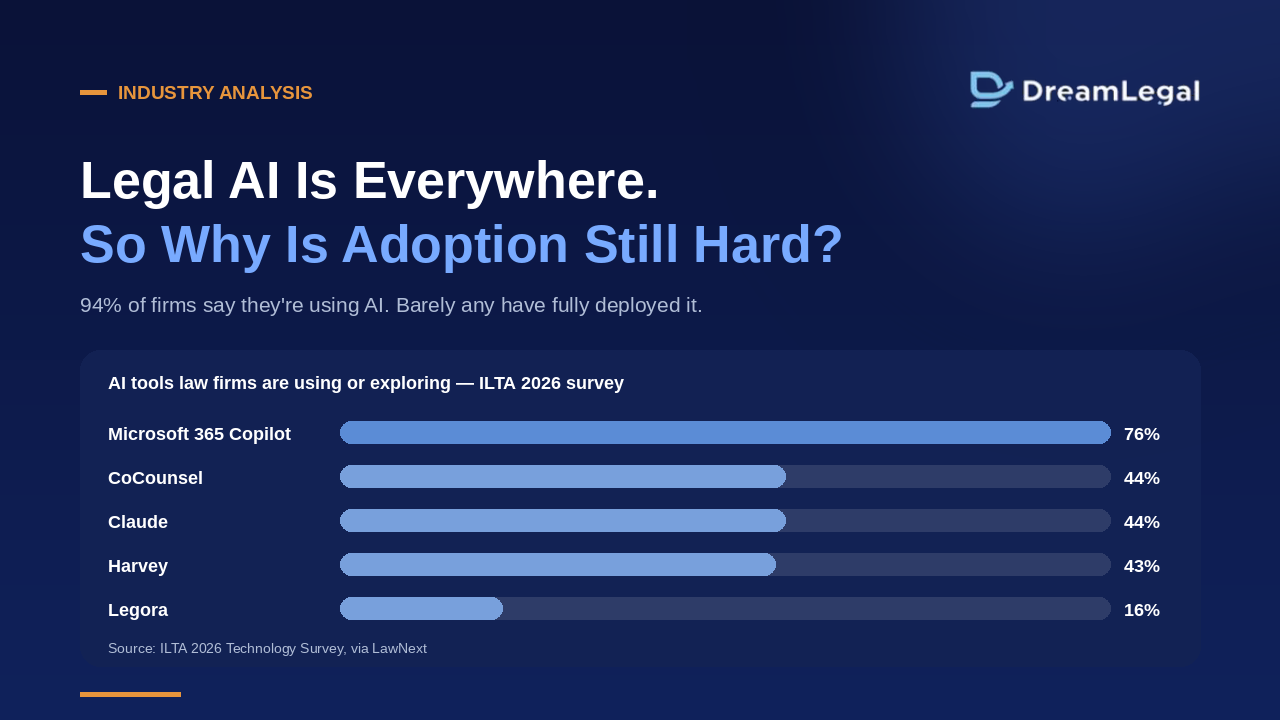
Ask ILTA's respondents which specific tool they use, and the picture gets more interesting:

Tool

Share of firms using or exploring it

Microsoft 365 Copilot

76%

CoCounsel

44%

Claude

44%

Harvey

43%

Lexis+AI

26%

ChatGPT Enterprise

22%

iManage

22%

Litera One

17%

Legora

16%

Source: ILTA 2026 Technology Survey, reported by LawNext, 14 September 2026.

Source: ILTA 2026 Technology Survey, reported by LawNext, 14 September 2026.

The three names most associated with “legal AI” as a category, CoCounsel, Harvey and Legora, don't top this list. Microsoft 365 Copilot does, by a wide margin. It isn't a legal-specific product. It already sits inside Outlook and Word, which lawyers open dozens of times a day. That's an integration advantage more than a capability advantage.

Firm size changes the picture further. Among firms with fewer than 50 lawyers, Copilot leads at 59%, followed by Claude (42%) and CoCounsel (40%). Harvey drops to 22% and Legora to 6% at this end of the market. Among firms with 700 or more lawyers, Copilot (88%) and Harvey (84%) sit close together at the top, and Claude is still ahead of Legora (47%) and CoCounsel (43%). A tool that dominates the large-firm segment barely registers among small firms, and the reverse holds too.

Usage and deployment are also two different things. Only two products in the survey, Microsoft Copilot and Westlaw Advantage, have been fully rolled out to at least half of lawyers at half of responding firms. Everything else sits mostly in testing. The most-piloted products are iManage AI Enrichment (91% of firms trying it), Ask iManage (80%), Claude (68%), Litera One (64%) and Legora (51%). Most of the industry, in other words, is still trying tools out rather than running them day to day.

The problem after the purchase

Consilio's 2026 Global Survey Report asked legal professionals to name their industry's biggest challenge. Workload volume didn't top the list. Understanding, selecting and deploying new technology did, cited by 54% of respondents, ahead of the volume of work itself.

That statistic explains the gap between the 94% headline and the low deployment numbers above. Legal teams aren't short of AI tools to try. They are short of a repeatable way to get a tool from pilot to daily use without breaking confidentiality rules, existing workflows or client trust.

A few examples show how long that process actually takes in practice. Shoosmiths ran a full year-long pilot, Project Apollo, before deploying AI firmwide. Macpherson Kelley spent a year evaluating Harvey and competing products before expanding to eight practice groups. Consilio and Legora worked together on live client deployments for more than fourteen months before either company put its name to a formal partnership. A year is now a normal timeline for a legal AI rollout, not an unusually cautious one

Integration, workflow and adoption

On 9 September 2026, Consilio and Legora made that fourteen-month working relationship official. The announcement itself wasn't about a new model or feature. It described implementation work: Consilio integrating Legora into a firm's existing matters, precedent databases and review workflows, and providing workflow design, governance, training and adoption support around it.

Kristin Thayer, Legora's VP of Partnerships, made the case that firms move faster when their implementation partner already understands their day-to-day workflows, not just the software itself. Consilio's president, Meredith Kildow, made a related point from the vendor side: the constraint for most legal teams isn't a shortage of AI options, it's whether they have the capacity to fit those options into their own systems and governance at the same time.

Speaking to Legal IT Insider, Consilio CEO Andy Macdonald put a number on how central this work has become. Integration and adoption services still account for under 10% of Consilio's revenue, but it's the fastest-growing part of the business. He also made an admission that captures the industry mood better than any survey statistic: his own personal use of AI tools has gone up roughly fiftyfold since January, and he still isn't convinced he's any more efficient because of it. That's the exact gap Consilio is now selling a fix for.

What this means for LegalTech buyers

The buying question is shifting. It used to be: which tool is the smartest? Increasingly, it's: which tool fits how my team already works, and who is going to run the rollout?

●       Integration depth – how far does the connection to the document management, practice management or research systems already in place actually go? A one-way data flow is a different proposition to a two-way one.

●       Governance – cited sources, audit trails, permission inheritance and ethical walls matter more in legal work than in most other AI use cases.

●       Training and change management – what does the vendor, or its implementation partner, actually provide beyond a licence key?

●       Realistic timelines – if a vendor promises deployment in weeks, ask why that differs from what firms such as Shoosmiths and Macpherson Kelley needed.

Where DreamLegal fits into this changing buyer journey

DreamLegal's own client data adds a further layer to the ILTA numbers. Across DreamLegal's client base, Legal AI adoption is concentrated inside the legal industry itself: Law Practice (43%) and Legal Services (20%) together make up 63% of adopters, ahead of Software Development (17%) and Financial Services (8%). Even as headline adoption climbs into the 90s, the buyers driving that number are still mostly law firms and legal service providers, not the wider pool of in-house corporate legal departments.

That unevenness, across tools, firm sizes, deployment stages and buyer types, is why comparison shopping in legal tech has got harder rather than easier as the market has grown. A buyer today is choosing not just a product but an implementation path: who will connect it to existing systems, who will train the team, and how success will be measured months after the contract is signed.

That's the layer DreamLegal's research is built around: comparing legal tech not only on features, but on how well it fits the workflows, data and buyer type a legal team actually has.

Sources: ILTA 2026 Technology Survey; LawNext (14 Sept 2026); Consilio 2026 Global Survey Report and press release (9 Sept 2026); Legal IT Insider (14 Sept 2026); DreamLegal Market Intelligence

Was this update helpful?

Stay informed

Make your next legal technology decision with more clarity.

Join DreamLegal for independent research, market perspectives, and practical evaluation guidance for legal teams.

Create Free Account