LEGAL AI
The Expanding Legal AI Ecosystem: The Shift Towards Connected Legal Workflows
How plugins, connectors, document applications and agents are carrying legal AI out of the standalone assistant and into the systems where legal work is drafted, recorded, reviewed and billed.
INDUSTRY ANALYSIS
From Standalone Assistants to Connected Systems
Plugins, connectors, document add-ins and agents are moving legal AI into the systems where legal work is drafted, recorded, reviewed and billed.
Between mid-September and the end of October 2026, the legal AI market produced an unusually dense sequence of launches (Figure 1). OpenAI introduced Astra for Law with 26 partner plugins. Microsoft brought legal plugins into Word and Copilot Cowork. Clio launched Workflows and Skills across its practice management suite, and Anthropic opened a gallery of legal artifacts inside Claude, built on more than 60 legal connectors added since May. In parallel, contract, eDiscovery and billing vendors released agents that operate inside their own platforms.
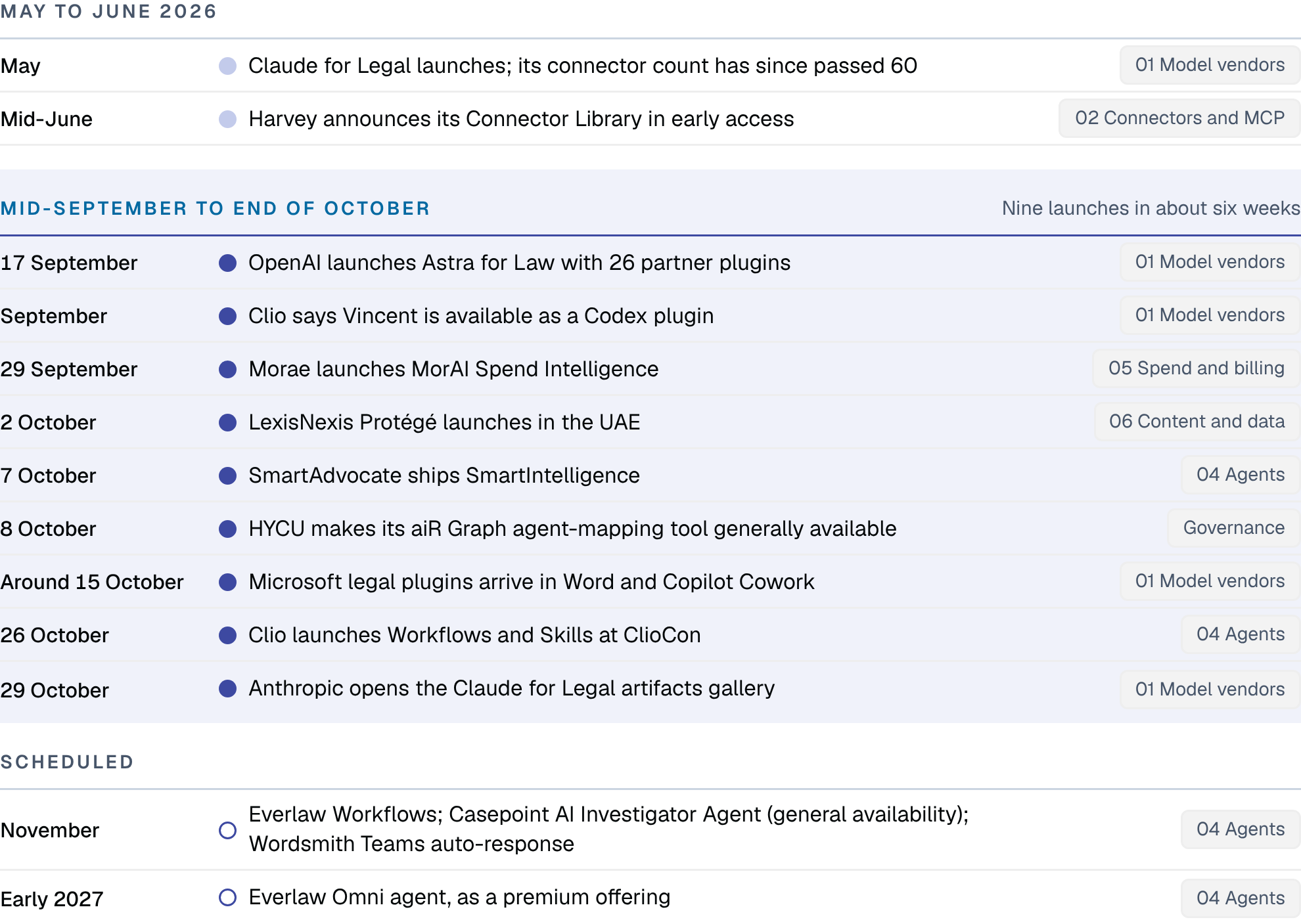
Source: DreamLegal market news and vendor announcements, developments to 31 October 2026. Scheduled items are as announced by the vendors.
Individually, these are product announcements. Collectively, they mark a change in where legal AI sits. Early generative legal tools were largely self-contained: a lawyer supplied a document or a question and carried the output back to the system where the matter lived. The current generation is designed to reach into those systems directly, reading from repositories and matter records and, increasingly, writing back to them.
THE CENTRAL SHIFT
Competitive position in legal AI is increasingly determined not only by what a model can do, but by the information it can access, the systems it can interact with and the workflows it can execute.
Data access, permissions, hosting and the limits placed on automated action now carry weight comparable to model quality in how these products are built, sold and governed.
TERMINOLOGY
The Changing Meaning of Integration
The vocabulary has not kept pace with the products. “Plugin” is currently applied to a Word add-in that redlines a contract, a connector that allows Claude to search a contract repository, a bundle of partner tools inside ChatGPT and an agent running inside a practice management system. These are different technical arrangements with different consequences for control of data, and treating them as interchangeable obscures the distinctions that matter.
In the broad sense used across the market, a plugin is any component that gives a general tool or platform new legal capability. A connector is narrower: a link between an AI assistant and another system, such as a contract repository, through which the assistant can search records or act on them. An add-in runs inside an application the lawyer already uses, typically Word, Outlook or Google Docs. An agent carries out a sequence of steps toward a goal rather than answering a single prompt. When an agent operates inside a system of record, the platform that holds the authoritative version of matters, contracts or documents, its role moves closer to that of a junior colleague than a tool.
DELIVERY MODELS
Three Delivery Environments
Almost every recent launch reaches legal users through one of three delivery models (Figure 2). In the first, a legal tool is made available inside a general AI assistant such as Claude, ChatGPT or Microsoft Copilot, as with LinkSquares inside Claude or Wordsmith inside ChatGPT; the assistant becomes the working surface and legal systems arrive as connected sources. In the second, AI sits inside Word, Outlook or Google Docs, where lawyers draft and redline, as with Legora, Lucio and Definely. Most of these tools work from a playbook, the organisation’s preferred positions on common clauses, against which they read a contract and propose redlines. In the third, AI is added to a platform already in use, such as contract management, document management or eDiscovery, as with Harvey, Clio, Everlaw and Relativity. This model suits teams seeking one governed environment and often requires nothing new to install.
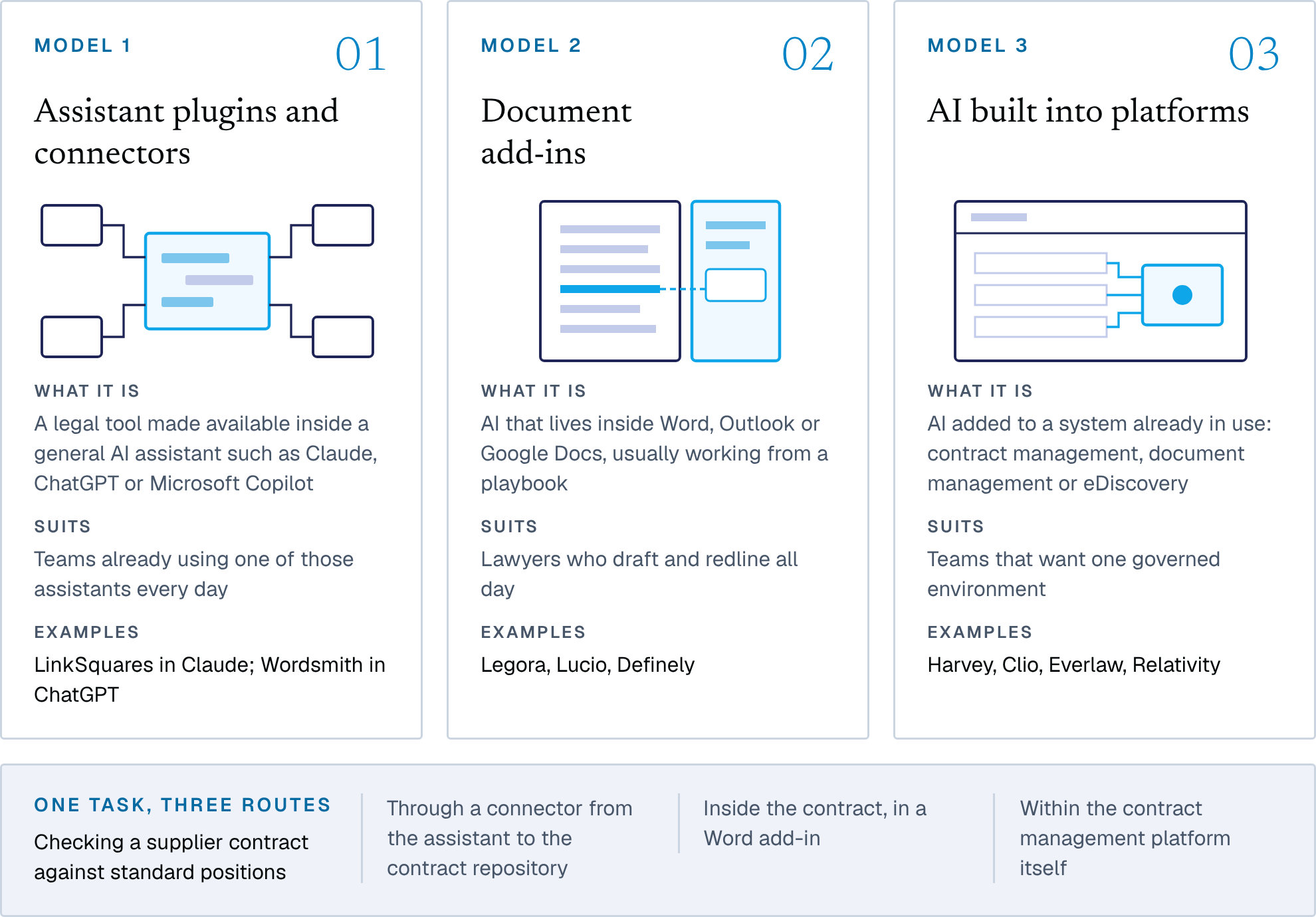
Source: DreamLegal analysis of product launches, May to October 2026.
The models increasingly converge on the same work. A supplier contract can be checked against standard positions in a Word add-in, through a connector from Claude to the contract repository, or within the contract management platform itself. The task does not change. What changes is where the user sits and who controls the data.
IN THE FULL REPORT
This is a preview. The full report continues with:
- Six Categories Shaping the Ecosystem
- From Connection to Execution
- Beyond Drafting: Spend, Billing and Specialist Applications
- Performance and the Evidence Behind It
- The Next Phase of Legal AI
It includes all six figures and five tables on the launches, connectors, agents and evidence covered, with sources.
Read the full report.
Every section, figure and table, with sources, in one PDF. Free for DreamLegal members: create an account and the download starts right away.
Compare tools
Add the tools from this article, then search for more.
 Lito
 Spellbook
 Clio
Read next
Legal AI
Everlaw unveils Omni agentic investigation suite and Workflows for document review
ReadWas this update helpful?
Sources
- 1Yahoo Tech: Anthropic's legal toolshttps://tech.yahoo.com/ai/claude/articles/anthropic-reveals-host-legal-tools-110500550.html
- 2TechOrange: Anthropic expands legal AI toolshttps://techorange.com/2026/05/13/anthropic-expands-legal-ai-tools-claude-cowork/
- 3The Next Web: OpenAI Astra for Lawhttps://thenextweb.com/news/openai-astra-for-law-gpt-6-legal-search-index
- 4Harvey: Connector Libraryhttps://www.harvey.ai/blog/connector-library
- 5Parley: integrations overviewhttps://ai.parley.so/integrations-overview-drafting-storage-export
- 6Clio: Vincent Codex pluginhttps://www.clio.com/about/press/clio-vincent-codex-plugin/
- 7Microsoft: Copilot for legalhttps://learn.microsoft.com/en-us/microsoft-365/admin/manage/manage-copilot-for-legal?view=o365-worldwide
Products mentioned









Continue reading
Related articles

Legal AI
Everlaw unveils Omni agentic investigation suite and Workflows for document review
Everlaw has announced Omni, an agentic AI investigation suite, and Workflows, a tool for designing and automating complex document reviews with human checkpoints. The company unveiled both at Everlaw Summit in San Francisco, alongside Everlaw for Word, which links legal writing to the case record.…
Read article
Legal AI
Legora and PointOne partner to log AI work as billable time automatically
Legora and PointOne will connect their platforms so that work lawyers do inside Legora is recorded as time entries in PointOne automatically. Each entry will carry the client, the matter number and a description of the task, tied to the lawyer who did the work and billed at that lawyer's rate. Law…
Read article
Legal AI
Anthropic adds legal artifacts gallery to Claude, with Harvey, PwC and Goodwin building tools
Anthropic has added a gallery of ready-made legal artifacts to Claude, giving legal teams interactive tools for contract review, regulatory tracking and request intake that they can adapt and share across the business. The release comes five months after Claude for Legal launched in May and…
Read articleStay informed
Make your next legal technology decision with more clarity.
Join DreamLegal for independent research, market perspectives, and practical evaluation guidance for legal teams.
Create Free Account