LEGAL TECH
DreamLegal: In Conversation with Ms. Anjali Sheoran, Director, Legal, Atlan
: In this interview of the Dream Legal podcast, the hosts speak with Ms. Anjali Sheoran a legal professional with experience across the building, buying, and strategy sides of legal technology for a candid conversation about how in-house legal teams truly operate and what thoughtful tech adoption looks like in practice.
Share article
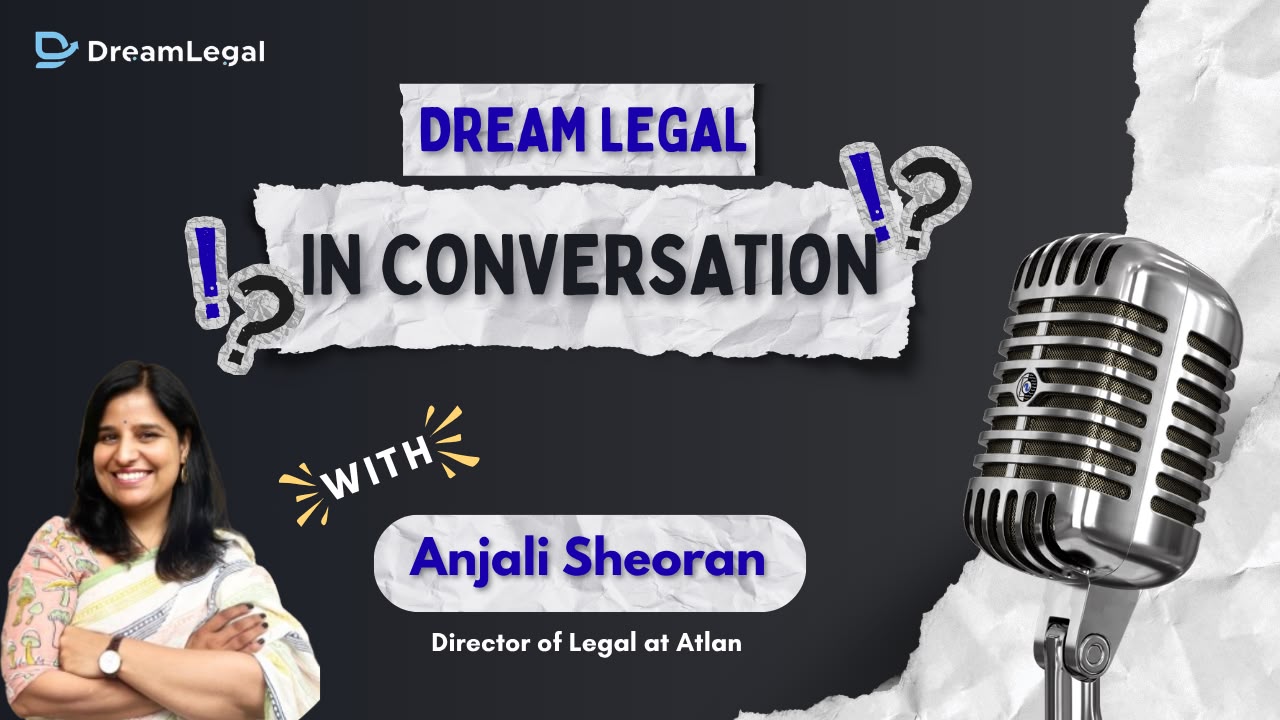
Ms. Anjali Sheoran opens with a reality check of how in-house counsel days are less about routine contract work and more about being the organization’s risk radar. She then walks through her framework for evaluating and adopting legal tech, emphasizing that decisions must be anchored in a specific problem statement, the company's current stage, and cross-functional needs. The conversation also explores the build versus buy question, the missing maker-checker mechanism in current AI redlining tools, and a significant unmet need in the market around capturing a company's institutional risk logic. She closes with practical advice for junior lawyers and startups, don't wait to learn the "right" way to use AI just start playing with it.
DreamLegal : Welcome, Anjali Ma’am ,thank you so much for taking the time today. We have been really looking forward to this conversation. At Dream Legal, we try to bridge the gap between legal tech vendors and the people who actually use it. Honestly, we don't think there could have been a better person to have this conversation with, given that you have been on the building side, the buying side, and the strategy side for such a long time. So, to begin, a lot of in-house counsels we have spoken to say that their week starts with contract redlines. We would love it if you could walk us through what your Monday mornings and your team's Monday mornings, actually look like.
Anjali Sheoran: I'd like to make a small correction our in-house days don't start with redlines. They start with being the organization’s panic button. The first question I'm answering on Monday morning is, “Who has spanned over the weekend?” About 70% of our time is taken up with deals, redlining, and negotiating contracts. But what I've realized over time is that more time needs to be spent in the windows when you're not working on deals thinking about efficiency, risk appetite, and constantly asking the business, “Have you thought about it from this angle?” What if the customer asks for this? What if our vendor doesn't deliver? That fight-or-flight mode is what we constantly exist between.
DreamLegal: Thank you so much for that correction the panic button analogy really lands. Now, one very important question, how do you actually go about adopting a legal AI tool who initiates it, and when do you pull the trigger?
Anjali Sheoran: Two things to consider. First: am I buying a tool to solve a problem, or because it's the best tool in the market right now? It doesn't work like law firms, where you carry a favorite partner to your next company. The tool must fit your specific problem statement whether that's something simple like a file repository, or something complex like extracting risk signals from contracts. Second where is your company overall? A team of two operates very differently from a team of 200. And something like a CLM is used by procurement and sales as well not just legal so that cross-functional purpose matters too.
DreamLegal: That makes a lot of sense. So, what happens when companies keep pushing adoption to the next quarter does that kind of deferral end up killing it entirely?
Anjali Sheoran: Sometimes it does. But legal teams are a cost center, and when budgets get cut, cost centers get cut first. It also depends on company size and the broader economy right now everyone is investing in AI, and sometimes you can justify that budget, sometimes you can't. Even if it feels like you're falling behind the current tech wave, sometimes it's just not the right time from a company perspective.
DreamLegal: As you explained, given that legal team is seen as a cost center, and you've worked closely with engineers have you ever considered just building a tool yourselves rather than buying one?
Anjali Sheoran: Yes, absolutely. A few weeks ago, I built an agent to solve a simple problem. Every company's context is different, and when you buy tools, you often realize they solve about 60% of what you need that remaining 40% is still missing. Recently, I was demoing a tool for in-house teams and realized I already have an enterprise tool that does the same work connects to Slack, gives updates, and so on. When I built the agent, I spoke to Claude directly, this is what I want, these are the guardrails. Once I had the framework, I went to my IT team and said, “I've done the homework, now help me deploy it.” I no longer need to spend time making engineers understand my problem. That iteration I can do with AI directly.
DreamLegal: That's a great point about looking beyond the hype. Are there any gaps in the market tools that would genuinely help in-house teams but haven't been built yet?
Anjali Sheoran: It's interesting that you mention that, because I was just discussing this with my product teams. Lawyers are expected to understand the ecosystem of policies and risk controls a company maintains, but we don't always have easy access to that information. Take a simple NDA, why don't we accept indemnity for confidentiality breaches? For a startup, that exposure could be existential. For a larger enterprise, the appetite might differ. If AI could help us understand why a company holds specific risk positions why we don't take on this liability, why we draft an audit clause this particular way that why could feed into playbooks and templates and make us genuinely more efficient. That's the gap I see.
DreamLegal: With over 200 contract management tools out there, how should a first-time buyer even begin to evaluate them?
Anjali Sheoran: The basic problem most CLM and AI tools aren't solving is the maker-checker concept. AI has progressed from simple copy-paste redlining to more intentional redlining integrating your position with what the third party has asked for. But what's still missing is oversight of the decision itself. If my general liability limit is $100 and a customer asks for $500, I might have two fallback positions. The tool lets a user select one but as a lawyer, I don't know why they chose it. A salesperson's priority in that moment is to close the deal, not manage company risk. If I hand that decision to a non-lawyer, there needs to be a trigger, person. A selected fallback one on an $800,000 deal why? That needs to route to legal for approval. The tools give you the playbook, flag non-compliant clauses, offer redline options but they don't look at the deal as a whole. They don't know what calls you had with the customer or what your sales team discussed. Only a human can know that.
DreamLegal: We can see how deep these answers go. With that, if someone has never adopted a legal tech tool before, what is the actual framework? What are the evaluation criteria to know it is the right call?
Anjali Sheoran: First do you even need a tool? If you're on a plateau and your work volume isn't increasing, a $20,000-a-year tool won't make a meaningful difference. But when volume grows and complexity increases that's the signal to invest. Scale too early and you create no difference; too late and you're behind. After that, it's about purpose, repository? Renewal tracking? Obligation extraction? Define it clearly. And experiment before committing I'm currently running two CLMs and piloting the new one on procurement first, because it's lower pressure than sales. Finally, don't limit yourself to legal tech. Consider general enterprise tools or even simple engineering scripts. A friend once told me a problem I had was just a standard script and I didn't need legal tech at all. Think of it as a legal team buying tech, not legal tech. That shift in mindset can open up better solutions.
DreamLegal: That's really clear. Shifting to compliance are current tools actually equipped to handle multi-jurisdictional requirements?
Anjali Sheoran: A quick correction I manage multiple jurisdictions, but not 20 countries. Focus your compliance investment on jurisdictions where your entities are located. For others, build a law firm network you can delegate to local experts who understand regional law. And this is where I'd push back on a common misconception, multi-jurisdictional nuance is not something AI has solved. The tools are producing better outputs and authenticated references, yes but the nuance a human expert brings is still irreplaceable. Always recheck AI output with a subject-matter expert. That's non-negotiable.
Host: Thank you for that detailed answer and really reassuring to hear that we are still not replaceable by AI! Now if Dream Legal had existed five years ago, how do you think it would have been useful for you, your team, and others?
Anjali Sheoran: What Dream Legal is doing is genuinely important. Most consultancies aren't focused on making life better for in-house counsel specifically they're focused on the company as a whole, which is different. When I was once replacing a compliance tool, the previous one from a Big Four was so unintuitive that it misread task completion dates as missed deadlines. The new tool actually reflected how legal work happens in practice. Dream Legal can help cut through business noise and help legal leaders identify what technology can actually improve their day-to-day. The more time we free up for legal teams, the better data they have — and the more effectively they can support the business.
DreamLegal: Thank you so much that really means a lot. And just the last question, if there is someone new to this field a startup, or a lawyer wanting to begin their legal technology journey what would your suggestions be?
Anjali Sheoran: Play with AI. Before you spend money on prompt engineering courses, just play with it. Take a Claude subscription and explore; see where it takes you. Once the fear is gone and you know how to use it as a tool, you can walk into any workspace and contribute meaningfully. It's like your first year of law school, you're not drafting plaints on day one you're learning, arguing, experimenting. That's where you should start. Don't get boxed into thinking there's a right way to learn this. There isn't.
This podcast was conducted and edited by the Dream Legal team
Anjali Sheoran is a seasoned corporate counsel with over 15 years of experience advising technology companies on complex legal, regulatory, and commercial matters. As Director, Legal at Atlan, she works at the intersection of law, technology, and innovation, with expertise spanning corporate law, startup law, commercial contracting, intellectual property, and legal operations. She is also an active voice in discussions on the evolving role of technology and AI in the legal profession
Was this update helpful?
Continue reading
Related articles

Legal Tech
The Economics of Legal AI: How Legal Tech Pricing Is Changing in 2026
Legal AI has moved past the pilot stage. In 2026, the money, the pricing models, and the buyer behavior in this industry all shifted at the same time. This report lays out what is actually happening in legal tech pricing this year, using deal data, product launches, and adoption numbers tracked by DreamLegal.
Read article
Legal Tech
The Rise of AI-Powered Contract Lifecycle Management Platforms
How agentic AI, no-code embedding, and prior-deal learning are resetting what in-house legal teams expect from CLM vendors
Read article
Legal Tech
AUGUST 2026 LEGAL TECH FEATURE LAUNCHES
Read articleStay informed
Make your next legal technology decision with more clarity.
Join DreamLegal for independent research, market perspectives, and practical evaluation guidance for legal teams.
Create Free Account