LEGAL TECH

LEGAL TECH ACQUISITION TRACKER: What Companies Are Buying, and Why

31 August 2026 7 min readDreamLegal Research

Share article

LEGAL TECH ACQUISITION TRACKER: What Companies Are Buying, and Why

The legal tech industry is going through its biggest wave of consolidation to date. In the last twelve months, deal activity has moved beyond small, niche purchases into large, headline-grabbing transactions that are reshaping how legal software companies compete.

This tracker breaks down the key acquisitions, investments, and strategic partnerships happening across legal tech right now, explains why each company made its move, and sets out what this means for vendors and buyers watching the space.

Deal Tracker: All Transactions At A Glance

The table below lists every deal covered in this report, in one place, for quick reference.

Date

Acquirer / Buyer

Target

Deal Value

Deal Type

Nov 12, 2025

Clio

vLex

$1 Billion

Acquisition

Nov 2025

Clio

Series G raise

$500 Million

Funding round

Nov 2025

Blackstone

Norm AI

$50 Million (investment)

Investment

Aug 27, 2026

StashAway

MakeGoodwill

Not disclosed

Acquisition

Not disclosed

Aline Technologies

Reg D offering

$5.05 Million

Securities offering

Source: DreamLegal Market Intelligence

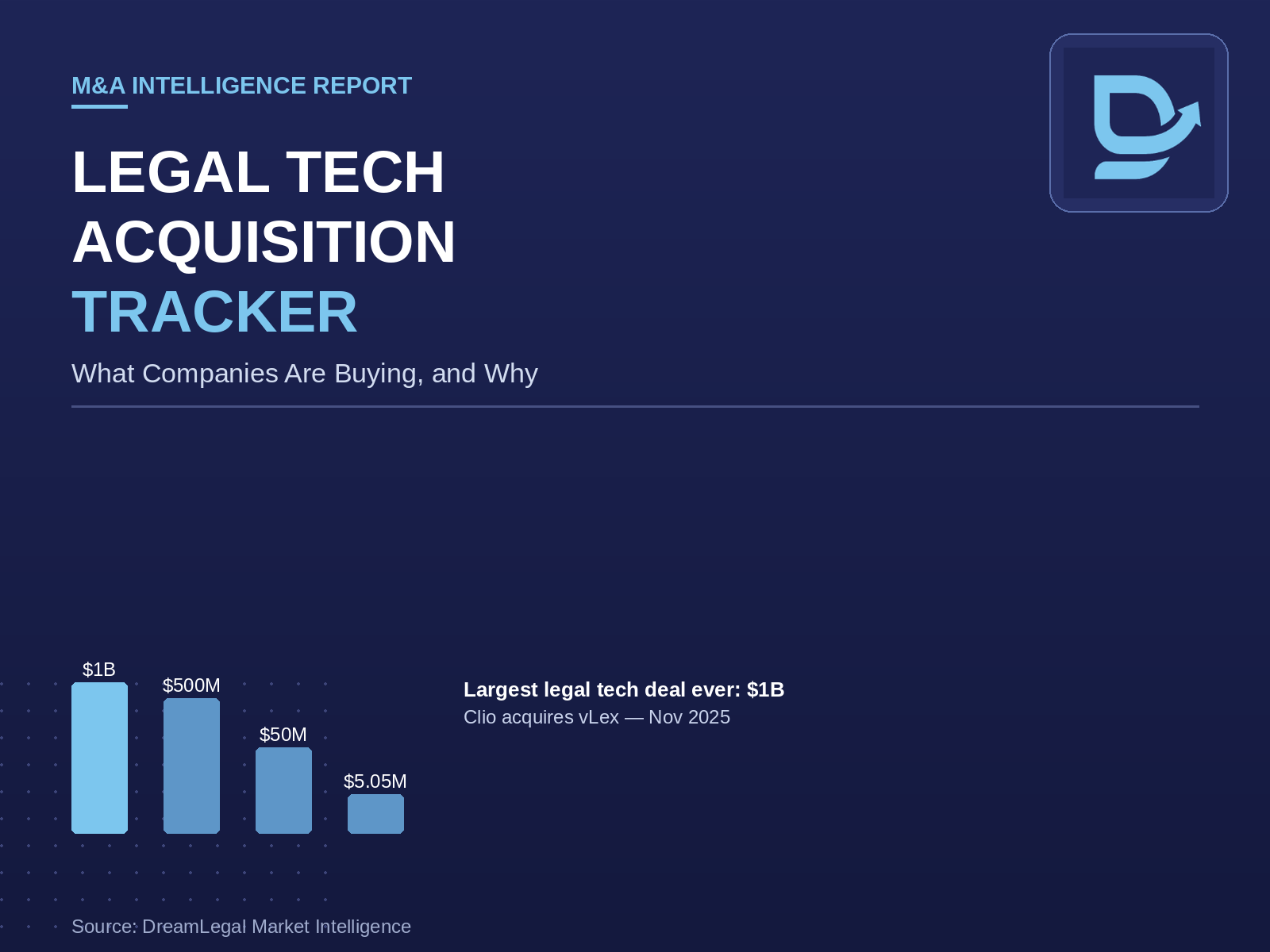
Deal Size Comparison

This chart shows the relative size of the disclosed deals in this tracker. The Clio-vLex acquisition is by far the largest, at $1 billion, roughly double the size of Clio's own funding round that closed alongside it.

Source: DreamLegal Market Intelligence. Bars are scaled relative to the largest deal ($1 billion = full bar). MakeGoodwill deal value was not disclosed and is not shown.

1. The Headline Deal: Clio Acquires vLex for $1 Billion

Date Closed: November 12, 2025

Deal Value: $1 Billion

Also Announced: A $500 Million Series G funding round, closed at the same time

This is the largest acquisition in the history of legal tech. It changes the shape of the market, so it is worth explaining in detail.

What Clio Bought

Clio acquired vLex, a global legal research platform. vLex brings:

•     Primary law content from more than 100 countries

•     Secondary legal sources, including the Vincent AI research assistant

•     An existing user base across law firms, corporate legal departments, and academic institutions

Why Clio Made This Move

Clio has long been the leading practice management platform for small and midsize law firms, covering billing, case management, and client intake. But it had one major gap: legal research.

•     Clio's existing base of more than 150,000 legal professionals had no built-in research tool

•     vLex's Vincent AI gives Clio a generative AI research tool built on verified legal content

•     Clio can now sell research tools directly into its own existing customer base

What This Means For The Market

•     Legal tech consolidation has moved from small add-on tools into core practice software. This is a deep integration move, not a small tuck-in purchase.

•     Owning proprietary legal content is now seen as the real asset. The AI layer is just the interface sitting on top of it.

•     Other small and midsize firm platforms, such as Smokeball, PracticePanther, and MyCase, are now under pressure to build or buy similar research capabilities or risk falling behind

2. StashAway Acquires MakeGoodwill: Wealthtech Meets Legal Tech

Date: August 27, 2026

Target: MakeGoodwill, a Singapore-based digital wills service

Acquirer: StashAway, a Southeast Asian wealth management platform

This deal looks different from the Clio-vLex deal. It is a wealthtech company buying its way into legal services, rather than one legal tech company buying another.

Why StashAway Made This Move

•     Lifecycle extension: StashAway manages client investments during their working years. Estate planning is the natural next stage, covering what happens to those assets after death.

•     Product bundling: combining automated investing with digital will preparation creates a complete wealth lifecycle offering, which few platforms in Asia currently provide.

•     Client stickiness: estate documents are high-trust and rarely switched between providers once set up. Owning MakeGoodwill's customers builds a long-term relationship.

What This Signals For Legal Tech Vendors

Estate planning software companies, such as MakeGoodwill and Trust and Will, are becoming acquisition targets for financial services platforms outside legal tech. Watch for similar moves in adjacent industries, including:

•     Accounting platforms acquiring tax compliance software

•     HR platforms acquiring employment law compliance tools

•     Insurance platforms acquiring legal document generation tools

3. Strategic Partnerships: The AI Platform Land Grab

Right now, the most active form of deal-making in legal tech is not acquisition. It is exclusive AI deployment partnerships between law firms and AI vendors. These deals function like quasi-acquisitions, locking in vendor relationships for years.

AI Vendor

Law Firm / Client

What Was Announced

Harvey

Finnegan

Deployed Harvey firmwide, paired with Finnegan's own IP law knowledge base

Thomson Reuters CoCounsel

Greenberg Traurig

Deployed CoCounsel Legal across roughly 3,200 lawyers globally

Google Cloud Gemini Enterprise

Weil Gotshal & Manges

Adopted Gemini Enterprise and launched its own BenchMark litigation AI tool

Eudia

Corporate legal teams

Embedded its legal AI agents inside Gemini Enterprise

Source: DreamLegal Market Intelligence

Why This Matters

These partnerships achieve much of what an acquisition would achieve, without the two companies actually merging. Vendors are effectively choosing between four strategies:

Strategy

Example

Best Suited For

Acquire content or IP

Clio buying vLex ($1 Billion)

Companies that need a proprietary data moat

Acquire adjacent verticals

StashAway buying MakeGoodwill

Companies extending the client lifecycle

Partner for distribution

Harvey with Finnegan; Eudia with Google Cloud

AI vendors needing enterprise trust quickly

Build proprietary platforms

Weil's BenchMark; BakerHostetler in-house tools

Firms wanting differentiation and control

Source: DreamLegal Market Intelligence

4. Secondary Deal and Funding Signals

Aline Technologies Files a $5.05 Million Offering

Company: Aline Technologies, an AI contract management platform

Action: Filed a Regulation D exempt securities offering

Early-stage AI contract management companies are raising capital to compete. This positions them for either continued growth or a future acquisition.

Norm AI Receives $50 Million From Blackstone

Investment: $50 Million from Blackstone, announced November 2025

Also Launched: Norm Law LLP, an AI-native law firm

Private equity is now directly funding AI-native legal service delivery. This creates a new type of competitor for both traditional law firms and existing legal tech vendors.

5. Why Companies Are Buying: Five Strategic Drivers

Across all the deal activity covered in this report, five strategic reasons keep appearing. The table below breaks each one down with a real example from the data.

Driver

What It Means

Example From The Data

1

Building an AI content moat

Clio bought vLex mainly for its legal content library, not just its AI tool

2

Cross-selling to an existing user base

Clio can now sell research tools to its 150,000+ existing SMB users

3

Extending the client lifecycle

StashAway added estate planning (MakeGoodwill) after investing services

4

Locking in enterprise trust through partnerships

Greenberg Traurig deployed CoCounsel across about 3,200 lawyers

5

Bundling multiple products together

Vendors combining CLM, research, AI, and compliance in one platform

Source: DreamLegal Market Intelligence

6. What This Means If You Are A Legal Tech Vendor

If You Compete In Contract Management

•     The contract lifecycle management (CLM) market is consolidating around platforms that also offer AI research and compliance depth

•     78% of legal professionals say they are ready to adopt CLM tools, but they will choose platforms with integrated AI

•     Vendors with a multi-AI approach need to clearly differentiate against competitors like Aline Technologies, who are actively raising capital to compete

If You Are A Compliance-Enabled Platform

•     Expect interest from adjacent industries, such as financial services and insurance, looking to add compliance capabilities they can bundle into their own products

•     Broad compliance tracking across many countries is a defensible asset, especially as cross-border compliance demands continue to rise

Acquisition Readiness Checklist

Use these four questions to assess how attractive your company would be to a potential acquirer.

Question To Ask Yourself

Why It Matters

Do you control proprietary data?

Vendors with unique legal or compliance content are prime targets

What point in the client lifecycle do you serve?

If another product touches clients earlier or later, an acquirer may want you

Is your AI actually differentiated?

General AI assistants are becoming commodities; specialized AI is harder to copy

Can you show cross-sell revenue?

Acquirers pay more for products that unlock revenue in an existing user base

Source: DreamLegal Market Intelligence

7. Watch This Space: Predictions For The Next 12 Months

Based on current deal activity and market signals, here is what to expect over the coming year.

No.

Prediction For The Next 12 Months

1

More hyperscaler partnerships as vendors race to integrate with Google's Gemini Enterprise for Legal

2

Consolidation in the estate and wills segment, following StashAway's move, likely drawing in more wealthtech and fintech buyers

3

Acquisitions of knowledge governance and document management layers, as agentic AI platforms deepen integrations

4

Consolidation among European compliance vendors as whistleblower and regulatory compliance rules expand across the EU

5

AI-native law firms, such as Norm Law, acquiring legal tech companies instead of building tools in-house

Source: DreamLegal Market Intelligence

Bottom Line

Three forces are driving legal tech M&A right now: the race to own proprietary AI content, the push to extend client relationships into adjacent services, and the consolidation of distribution through firm-wide enterprise AI deployments.

Key Takeaway For Vendors

• Differentiate on proprietary data, not just AI features

• Demonstrate clear cross-sell potential within your existing user base

• Watch adjacent industries (finance, insurance, HR) that may see your capabilities as a missing piece in their own platform

• The window to build strategic value and position for a deal is open now

All data in this report is sourced from DreamLegal Market Intelligence.

Was this update helpful?

Stay informed

Make your next legal technology decision with more clarity.

Join DreamLegal for independent research, market perspectives, and practical evaluation guidance for legal teams.

Create Free Account