CONTRACT LIFECYCLE MANAGEMENT (CLM)
DreamLegal: In Conversation with Andrew Leverone, Chief Product Officer at LinkSquares
LinkSquares recently introduced Workflow Builder Agent and Workflow Blueprints, two new capabilities designed to change how legal teams build and adapt contract workflows. We spoke with Andrew Leverone, Chief Product Officer at LinkSquares and a member of its founding team, to dig deeper into the thinking behind the launch.
Share article
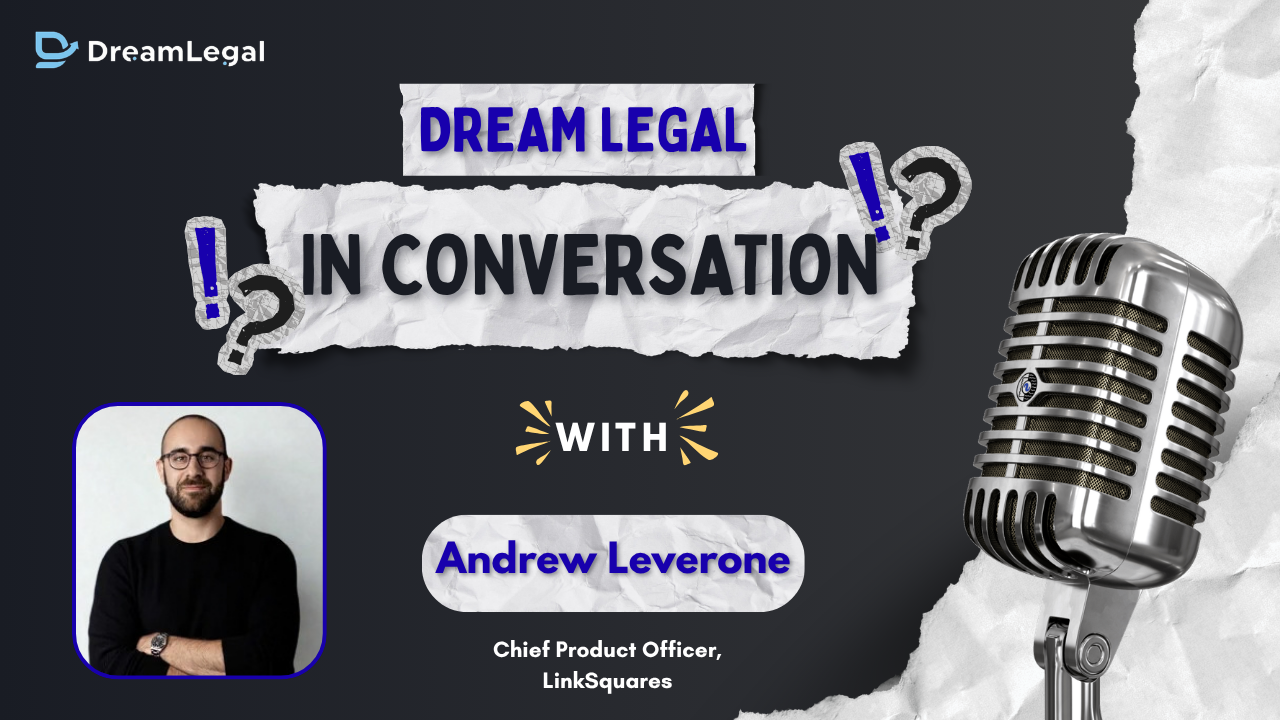
LinkSquares recently introduced Workflow Builder Agent and Workflow Blueprints, two new capabilities designed to change how legal teams build and adapt contract workflows. The announcement caught our attention—not simply as another product feature launch, but because it touches on a persistent challenge in legal technology: making complex workflows easier to build, modify, and maintain without requiring teams to become workflow configuration experts.
We spoke with Andrew Leverone, Chief Product Officer at LinkSquares and a member of its founding team, to dig deeper into the thinking behind the launch. In this conversation, Andrew explains what led LinkSquares to build these capabilities, how Workflow Builder Agent works in practice, the role of natural language and AI in workflow creation, and what the shift toward more agentic contract technology could mean for the future of CLM.
Andrew Leverone joined LinkSquares in 2017 as part of the founding team and initially worked in product. Since then, he has taken on engineering, design, and IT responsibilities and currently serves as Chief Product Officer.
DreamLegal: LinkSquares introduced Workflow Builder and Workflow Blueprints. For someone hearing about these capabilities for the first time, what exactly are they?
Andrew Leverone: At a high level, they are fairly simple concepts, although there is quite a lot happening under the hood.
Workflow Builder is essentially a natural-language prompting engine that allows users to build workflows using plain language. Blueprints are templates of workflows that we see repeatedly across our customer base. We have been doing this for a long time, so we have seen a lot of the same use cases occur repeatedly.
When there is a common workflow, it does not necessarily make sense for every customer to build it from scratch. A template gives them a starting point. There is also a time-to-value element. Legal technology can take some time to implement because teams have to bring their contracts together, build workflows and collaborate around that process. Blueprints are another way to accelerate that time to value and give users something to start with from day one.
DreamLegal: What challenges were you seeing among customers that led LinkSquares to build these capabilities?
Andrew Leverone: Workflows are a key part of legal technology, but there are really two sides to them. There is what people want workflows to be and then there is the reality of building and maintaining them.
People often imagine building a machine with a series of steps, turning it on and having the company run like a well-oiled machine. That is the expectation. But in practice, especially in large organisations with large teams, multiple steps and a lot of complexity, workflows can be difficult to build.
The other major challenge is maintaining them. You might build a workflow involving legal, finance and other departments, with standards and conditional logic built into it. But what happens when the business changes? What happens when people leave, or regulations change? You then have to go back and modify the workflows. That could mean changing one or two workflows or potentially hundreds of them.
So the creation and maintenance of workflows can be a significant time burden when setting up legal technology inside a business. Andrew also sees this as closely connected to the post-signature side of legal technology, where the information and outputs generated through workflows feed into analysis and ongoing contract management.
Traditionally, building a workflow involved dropdowns, adding different steps, and manually adding conditional logic. Then we moved into drag-and-drop and no-code builders. But with large language models and the technology available today, we can take a much bigger step forward and allow users to create, maintain, and edit workflows using natural language.
DreamLegal: Could you give us a practical example of how a legal team could use Workflow Builder in its day-to-day work?
Andrew Leverone: A good example would be a vendor MSA workflow.
You have the trigger, the steps and the sequence. You have the fields you need to create, the conditional logic and the routing. Instead of setting all of that up manually, you could say something like, “Create a vendor intake workflow. The first step should be an upload step where the user uploads a document. The next step should run it through our playbook and suggest language. Anything over $50,000 should involve our Head of Legal, while anything below that does not need their involvement. After legal, send it to finance, and then send a summary to Slack so the team has visibility that the approval chain has been completed.”
You could take that loose description and put it into the engine, and it can build an actual workflow for you. Large language models are very good at taking a conversation and then taking action from it. In this case, that means automatically building the workflow.
DreamLegal: How mature are legal teams today when it comes to describing their workflows and translating them into automated workflows?
Andrew Leverone: I will be really transparent here because this is a cutting-edge feature that is still new. We do not have a ton of data around it yet. Ask me again in a year and I think we will have a lot more.
The initial reactions have been very positive. I think enough time has passed with tools like ChatGPT and Claude that people are now comfortable with how prompting works.
If we had released this a year ago, I think it might have been too early. But there is now enough familiarity that the teams we are seeing as early adopters are able to get up and running with the feature relatively quickly.
It also goes back to the pain point they have had for so long. They do not have to go through the drag-and-drop process, particularly when it comes to editing and maintenance. They can create the workflow and then simply say, “I do not really like that,” or change a conditional rule from $50,000 to $60,000, or add additional people.
The ease of use is definitely there, but we are still in the early innings.
DreamLegal: How accurately can the system replicate the workflows that legal teams are trying to build? How much learning and modification is still involved?
Andrew Leverone: This is actually a great use case for large language models, so the accuracy has been quite high.
We have always had a philosophy of getting users about 80% of the way there. If you have 100% of the job to do, we want to do 80% of the work and then embrace the human-in-the-loop aspect for the remaining 20%. That allows the user to verify the output, feel good about it and make corrections where necessary.
For this particular use case, maybe the ratio is closer to 90% of the way there. If you wrote a workflow that was extremely technical and sophisticated, there is probably an upper limit to how accurate it can be.
But for the common use cases we see with the teams we work with, I think the accuracy is quite high. We are not striving to get to 100%. We are striving to get users as close as possible and then give them the tools to get the rest of the way there.
That is also where the ability to continue editing the workflow through natural language becomes important. If something is slightly off, it is easy to make the correction.
DreamLegal: LinkSquares now offers two ways to build workflows, through conversational workflows and Blueprints. Are there particular use cases where you would recommend one over the other?
Andrew Leverone: Things like NDAs and DPAs are really standard workflows where we see a lot of overlap in how users handle them. For those kinds of workflows, I would suggest using them out of the box.
The nice thing is that you can use natural language on any template, whether you created it from scratch or started with a Blueprint. A Blueprint can simply be a good starting point. You might use the NDA Blueprint and then have a small change you want to make. You can just use natural language to edit that workflow.
So I think a Blueprint can either be something you use as it is or a starting point that gets you moving instead of beginning completely from scratch.
DreamLegal: “Agentic” has become a widely used term in legal technology. What does agentic mean to you, and how is LinkSquares approaching it?
Andrew Leverone: It is a great question, and it is kind of loaded. There is not a clear definition. If you look it up, there is probably a definition of an agent, but there is also a debate among technology leaders and thought leaders about what the term really means. I think it is being used pretty loosely from a marketing standpoint.
From my perspective, agentic is really two things. It is streamlining user experience with less prompting and oversight, and it is also a way of building infrastructure.
What I do not think agentic is, is having a legacy platform and simply attaching an agent to it.
We rebuilt our entire product from scratch to enable autonomous AI, and we started that journey before “agentic” tools became more mainstream. Everything we built from the ground up was designed to serve the autonomous agent experience.
In traditional software development, we think about user stories and user experience. We also need to think about the agent story and the agent experience. The infrastructure and the entire user experience need to be built in a way that allows agents to thrive.
Standing up agents is easy. Creating an environment where agents can actually be successful is much harder. I think enabling successful agentic AI is much more about the environment and infrastructure needed to support how the agents are working more than the agents themselves.
DreamLegal: Are these product changes driven primarily by requests from existing customers, or are they also based on how you see legal technology and legal teams evolving?
Andrew Leverone: We are in a challenging situation, which has actually been really fun, because we have to play in both worlds.
We have a lot of customers who are already on our existing platform, and we need to serve those needs. They are using a platform they know and have been using for years.
At the same time, we are capturing new prospects and customers who are looking at cutting-edge technology and pressing us for more futuristic capabilities.
So we have to serve both at the same time and find that balance.
I think we see this in technology a lot. Engineers and people who are close to technology can get very excited about the future and become ambitious about bringing futuristic technology to users too soon. That can become a problem if people are not sure how to use it or why they need it.
The goal is to introduce the technology in a way that actually helps people and delivers value rather than simply giving them the latest model.
That balance is important in the new product as well. People still like repositories and tables with lots of columns and data. There is a certain amount of prompting fatigue. People do not necessarily want to log into an application and prompt for everything.
Natural language makes a lot of sense in some places, such as a workflow builder. But there are other areas, such as dashboards, where people may still want traditional dashboards and information that is already saved and available.
So I think the customer base has pushed us to find that balance and continue delivering value regardless of whether an LLM is involved.
DreamLegal: As technology moves quickly and features become easier to replicate, where do you think meaningful differentiation will come from?
Andrew Leverone: Technology is moving so fast that technology moats are becoming very thin. The day you come out with something different, someone else can come out with something similar.
So I think companies need to find new places to differentiate.
Having an amazing product and continuing to push the technology is almost a requirement now. But the way you treat customers, the feeling of the brand and all of those things are becoming more important than ever.
We have an advantage because we have a lot of historical context, customers, and data, which is valuable.
But one of our differentiators as a company is that we really strive to be customer-first and go out of our way to take care of our customers.
DreamLegal: You have spoken about closing the loop between pre-signature and post-signature work. What does that future look like for legal teams?
Andrew Leverone: There is a larger use case in legal technology that has not been solved yet, which is the full loop between post-signature data and all the historical context of what you have agreed to and done as a team or company, and having that actually feed the pre-signature experience in real time.
Today, those areas can be quite disjointed. If you are very focused on redlining and drafting but do not have rich post-signature data, you are missing that context. If you are very deep on post-signature work, you are missing the ability to redline, draft, and handle the workflow side.
We have been on a path for a long time to close that loop, so that when you are in a pre-signature negotiation or workflow, insights from the repository and the organisation's history can actually help you make decisions.
A few companies in the space have started approaching this through playbooks. You can build a playbook and then use it, but that still involves manual effort.
What we have been trying to push toward is a point where you do not build the playbook yourself. You upload all your data and contracts, the tool learns from your preferences and the things you do every day, and in real time it serves that information to you when you are in a new negotiation or renegotiation.
I think that is the dream. With the technology where it is today, I think we have what we need to really be able to close that loop and have a system that is feeding on itself, creating more value from the context it has accumulated.
DreamLegal: Looking a year ahead, what do you think legal teams will be able to do with LinkSquares that they simply cannot do today?
Andrew Leverone: I think closing that loop will be pretty amazing.
When you do not need to build playbooks and more workflows can become pre-manufactured because the system can absorb the context of your business, who you are, what you are trying to do, your business goals, your business strategy, the people in your business, and the contracts under management, the system can become much more proactive.
You show up and have a new deal on your desk, and the system can proactively feed you insights based on that historical knowledge and company context. It can really become a partner.
The fancy way to say that is that there will be lots of agents and different skills that we are building in order to orchestrate all of that. But aside from talking about agents, the real value we want to deliver is getting those insights and getting things done faster.
DreamLegal: With the legal technology market moving so quickly and so many products making different claims, what do you think is becoming most difficult for legal technology buyers today?
Andrew Leverone: The market is hot right now. There is a lot of stuff going on, and there are a lot of claims of people doing X, Y or Z.
I really appreciate the work you are doing to paint what that picture looks like and help people make sense of it all, because I think it is hard to be a legal buyer right now.
There is a lot of paralysis by analysis. It is hard to read through the claims and the approaches, compare all the competitors and make sense of everything.
I think you are doing a great service for the space. I really appreciate the work you are doing to help people make sense of it all. Thank you as well for the time. This was awesome.
This interview was conducted and edited by the DreamLegal team.
Was this update helpful?
Products mentioned

Continue reading
Related articles

Contract Lifecycle Management (CLM)
Leah Launches Agentic Contracting Platform as CLM Model Faces Enterprise Reset
Read article
Contract Lifecycle Management (CLM)
LinkSquares Adds AI Workflow Construction Tools to Its Contract Management Platform
On Sept. 16, LinkSquares introduced two AI-driven tools designed to let legal and business teams build contract workflows from plain-language instructions.
Read article
Contract Lifecycle Management (CLM)
BearingPoint Connects GenAIQ to DocuSign IAM for Contract Value Recovery
Read articleStay informed
Make your next legal technology decision with more clarity.
Join DreamLegal for independent research, market perspectives, and practical evaluation guidance for legal teams.
Create Free Account