LITIGATION CASE MANAGEMENT
Litmas AI launches Agentic Associate to draft source-linked litigation filings
Litmas AI has launched Agentic Associate, a litigation assistant that joins legal research, case facts and drafting in a single workflow. The company says the tool produces filings close to ready for court, with each fact traced to the case record. Litigation tools remain fragmented Litigators have…
Litmas AI has launched Agentic Associate, a litigation assistant that joins legal research, case facts and drafting in a single workflow. The company says the tool produces filings close to ready for court, with each fact traced to the case record.
Litigation tools remain fragmented
Litigators have long stitched together separate systems for research, document review and drafting. Generative AI has added to that pile rather than replacing it. Many tools produce fluent text that lawyers must still verify line by line, which erodes the time they promise to save.
Citation risk has sharpened that concern. Courts have sanctioned lawyers for filing briefs with invented authority, and a recent report described a prosecutor citing a nonexistent case after an AI search. Vendors now compete on traceability as much as speed.
Evidence Mapper ties facts to the record
Litmas built Evidence Mapper to group facts into storylines supporting a claim. Each fact links to underlying material such as depositions, exhibits and medical records. The platform covers pleadings, demand letters and motions, with formatting for state and federal courts.
The company says its best-case summary-judgment draft takes as little as 90 minutes, against the three and a half to four weeks it describes as typical. It also reports motion-drafting time falling 60 to 80 percent. It reports no fabricated citations to date and says citations pass through a checking tool.
Litmas says more than 200 firms use the product, which it says has supported 1,500 matters and over 3,000 filings. Ducos Law Firm, the named customer, says average case expenses fell by roughly two-thirds and that it can handle nearly twice its prior caseload. All figures come from the company's release, not independent testing.
Source-linked drafting is becoming the benchmark
The launch shows where litigation-focused legal AI is heading. Vendors are moving from general drafting assistants toward agent-style tools that carry a matter from record to filing. Anchoring output to evidence is meant to answer the trust problem that has slowed adoption at cautious firms.
Plaintiff-side and small firms may feel the pull first. Their margins depend on case volume, and the Ducos testimonial points to capacity as the selling point. Larger firms will weigh the same gains against malpractice exposure and client scrutiny of AI use.
A citation check confirms a case exists. It does not confirm the case supports the argument, or that a factual storyline is fairly drawn from the record. Buyers will press vendors on that gap.
DreamLegal Perspective
The claim to watch is not the 90-minute draft but the review burden that follows it. Legal operations teams evaluating litigation AI should ask vendors for results on error rates in legal reasoning and factual characterization, not just citation accuracy, and should pilot tools on closed matters where outcomes are known. Vendors that publish independent benchmarks and document how lawyers verify output will have an edge as courts and clients tighten expectations. Speed claims will keep converging across the market. Verifiability will not.
Was this update helpful?
Sources
- 1superpowerdaily.comhttps://superpowerdaily.com/posts/litmas-ai-launches-litigation-assistant-to-connect-research-case-facts-and-drafting
Continue reading
Related articles

Litigation Case Management
EstateMin Closes €1M Pre-Seed to Automate U.S. Trust and Estate Law Firms
EstateMin, an AI-powered platform targeting U.S. trust and estate law firms, has closed a €1 million pre-seed round to accelerate its American expansion. The New York-headquartered company — founded in Ireland in 2024 — is reporting 20 percent month-on-month revenue growth, a metric that will…
Read article
Litigation Case Management
Steno Launches Litigation Genius to Turn Case Files Into a Unified AI Workspace
Read article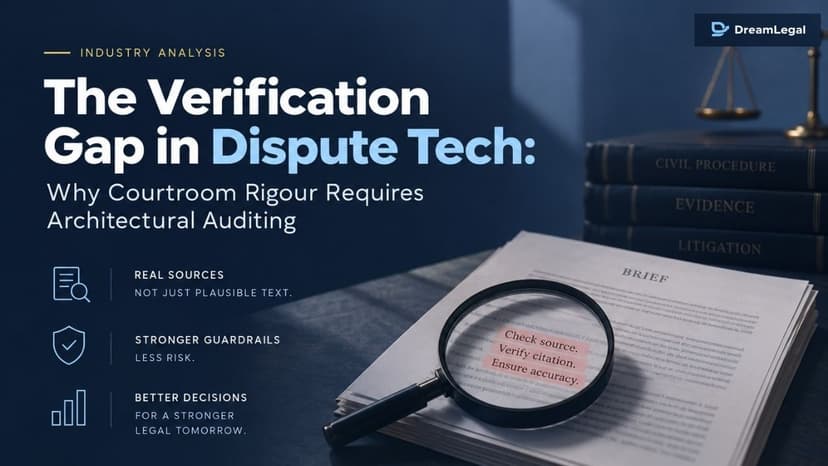
Litigation Case Management
The Verification Gap in Dispute Tech: Why Courtroom Rigour Requires Architectural Auditing
Read articleStay informed
Make your next legal technology decision with more clarity.
Join DreamLegal for independent research, market perspectives, and practical evaluation guidance for legal teams.
Create Free Account