LEGAL TECH

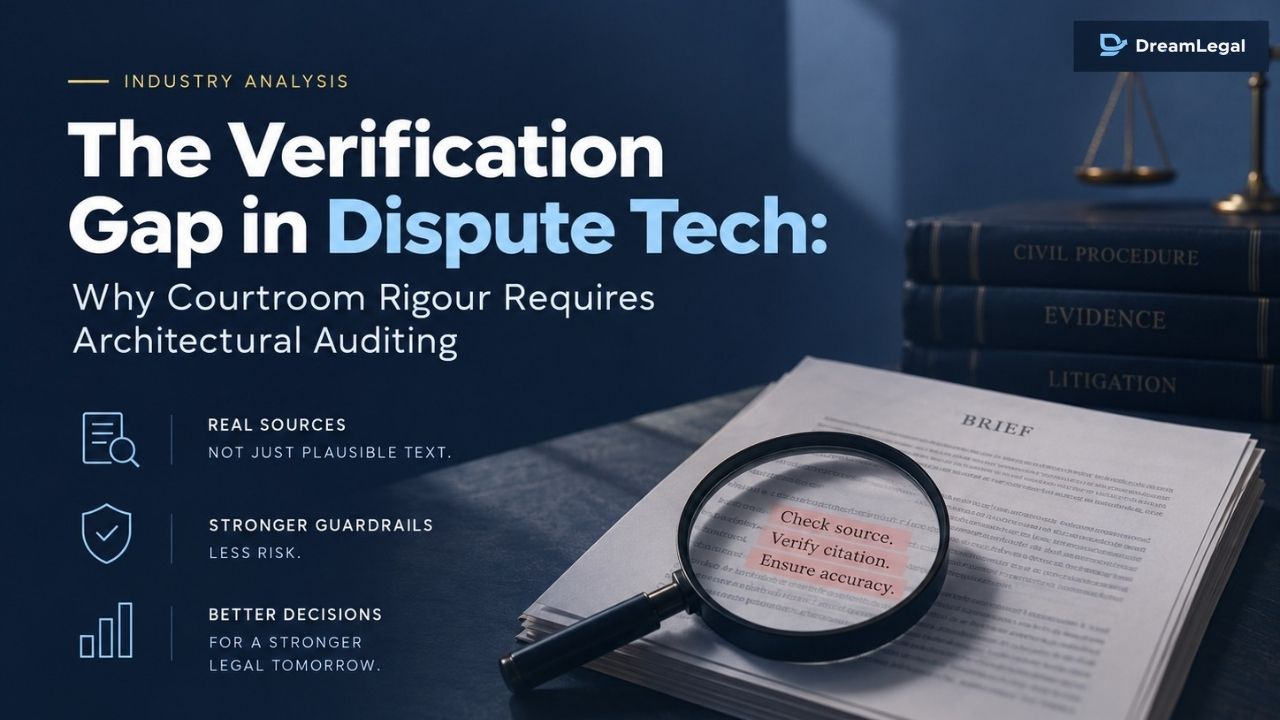
The Verification Gap in Dispute Tech: Why Courtroom Rigour Requires Architectural Auditing 

10 September 2026 5 min readDreamLegal Research

Share article

The Verification Gap in Dispute Tech: Why Courtroom Rigour Requires Architectural Auditing 

A federal judge in the U.S. District Court for the District of Arizona formally reprimanded an attorney after discovering artificial intelligence errors across four consecutive briefs filed in an active employment discrimination lawsuit. The filings contained fabricated quotations and an erroneous case summary produced by AI. Compounding the issue, this was not an isolated misstep; the attorney had already faced sanctions on two separate prior occasions for violating court procedural rules. 

Across the legal sector, the reaction followed a familiar refrain: warnings about the hazards of generative software in legal practice. 

Yet framing this incident as proof that AI has no place in litigation misidentifies the operational failure. The breakdown was not the decision to adopt technology; it was the total absence of an architectural and procedural verification gate between machine synthesis and the court docket. 


The High Cost of the Missing Verification Layer 

Litigation practices and eDiscovery teams face unrelenting pressure to accelerate cycle times across deposition summaries, document review, and motion drafting. Modern language models excel at rapid narrative generation, structuring arguments and synthesizing complex factual records in seconds. 

However, foundation models are probabilistic engines optimized for linguistic fluency, not jurisdictional accuracy. When prompted to support an argument under tight filing deadlines, an unanchored model introduces distinct structural hazards: 

  • Fabricated Quotations: Generative models routinely paraphrase legal principles and place them inside quotation marks to preserve natural prose, producing synthetic judicial statements that never occurred. 

  • Mismatched Authority: An engine may articulate a valid point of law, yet anchor it to a real case citation that addressed a completely different doctrine or procedural posture. 

  • Procedural Distortion: Automated summaries frequently blend procedural standards, silently blurring the evidentiary burden required between a preliminary motion to dismiss and summary judgment. 

Mandating that associates cross-check citations is an important operational policy, but manual review under midnight deadlines remains vulnerable to human oversight. When an ungrounded model outputs plausible text, human reviewers can miss subtle inaccuracies. A firm cannot patch an architectural vulnerability solely through workflow memos; factual defensibility must be evaluated at the software level before a tool is ever deployed. 


Evaluating Beyond the Feature List: How Litigation AI Is Audited 

Most litigation tech marketing pages look identical. Nearly every vendor claims accelerated brief drafting, intelligent search, and high accuracy. But what separates an enterprise-grade platform from a high-risk malpractice liability is the technical engineering beneath the interface: 

  • Retrieval Architecture: Does the tool rely on an open foundation model API, or does it enforce Retrieval-Augmented Generation (RAG) anchored strictly to a closed, verified legal corpus? 

  • Source Lineage and Auditability: Does the system provide document-level provenance, enabling an attorney to click through directly to the exact paragraph of the primary docket entry, transcript, or statutory code that generated the assertion? 

  • Deterministic Guardrails: What safety mechanisms exist within the platform to flag or prevent the export of unanchored assertions? 

Understanding these operational nuances is where independent marketplace auditing becomes essential. Evaluating dispute technology cannot rely on vendor-led product demos or unverified claims. Teams need access to objective, standardized data. 


Benchmarking Court-Ready Platforms 

Navigating this procurement challenge requires an objective baseline that categorizes and benchmarks software on technical rigour rather than marketing claims. 

The Litigation & Dispute Resolution use case on DreamLegal tracks 227 tools across 3 core operational categories

  • Litigation Case Management (92 Tools): Managing active litigation matters end-to-end, tracking case intake, deadlines, and docket workflows. 

  • Litigation Analytics (82 Tools): Evaluating predictive and statistical analysis of judges, courts, and case outcomes. 

  • eDiscovery (124 Tools): Identifying, collecting, and reviewing massive document volumes for relevance and privilege. 

Within this framework, litigation practitioners, legal operations leads, and technology committees evaluate software through four specific dimensions: 

  • Standardized Product Descriptions: Objective, functional breakdowns that strip away marketing buzzwords to document actual deployment types, integration compatibility, and data security postures. 

  • Vetted Legal AI Case Studies: Practical performance histories detailing how peer litigation teams deployed specific AI tools, including operational hurdles and adoption timelines. 

  • Market Tracking for Professional Upgradation: Continuous intelligence on product updates, emerging AI tools, and evolving category standards, enabling practitioners and legal operations leads to stay current with legal market trends. 

  • Exportable Side-by-Side Comparisons: The ability to select competing vendors, compare functional specs and verification architectures side-by-side, and export a standardized audit sheet directly for internal stakeholders, IT review, and executive sign-off. 


Closing the Verification Gap Before the Filing Deadline 

The Arizona reprimand makes one operational truth undeniable: when an algorithm hallucinates a precedent or invents a quotation, the court does not hold the software developer accountable; it sanctions the attorney of record. Relying on good faith or hoping that a rushed midnight cite-check catches every fabricated line is a high-stakes gamble with firm credibility. 

Defensibility cannot depend solely on human vigilance after a draft is generated. It has to be built into the technology stack itself. Before an organization commits to an AI drafting or eDiscovery platform, leadership must know exactly how that tool interrogates source data, where its retrieval boundaries lie, and whether it prevents hallucinations before they ever touch a draft. 

Bridging this gap is precisely why independent platform auditing has become indispensable. Rather than relying on sales promises or discovering architectural blind spots before a federal judge, litigation teams use DreamLegal to benchmark verification mechanisms, scrutinize real-world AI deployment data, and export side-by-side vendor comparisons. Adopting AI shouldn't mean inheriting unmanaged risk; by selecting tools built and audited for courtroom rigour, dispute practices ensure every automated workflow remains grounded, verifiable, and fully defensible from the first prompt. 

Was this update helpful?

Sources

  1. 1
    Arizona Atty Reprimanded For Series Of AI Errorshttps://www.law360.com/legalindustry/articles/2517696
  2. 2
    Litigation & Dispute Resolutionhttps://dreamlegal.in/use-case/litigation-dispute-resolution

Stay informed

Make your next legal technology decision with more clarity.

Join DreamLegal for independent research, market perspectives, and practical evaluation guidance for legal teams.

Create Free Account