REGULATORY COMPLIANCE

NAITRA Bill 2024 & AI Employee Protection Bill 2023

Private member bills on AI regulation have been introduced in the Rajya Sabha - the National Artificial Intelligence Technology Regulatory Authority Bill 2024 and the Artificial Intelligence (Protecti

31 July 2025 9 min readDreamLegal Research

Share article

NAITRA Bill 2024 & AI Employee Protection Bill 2023

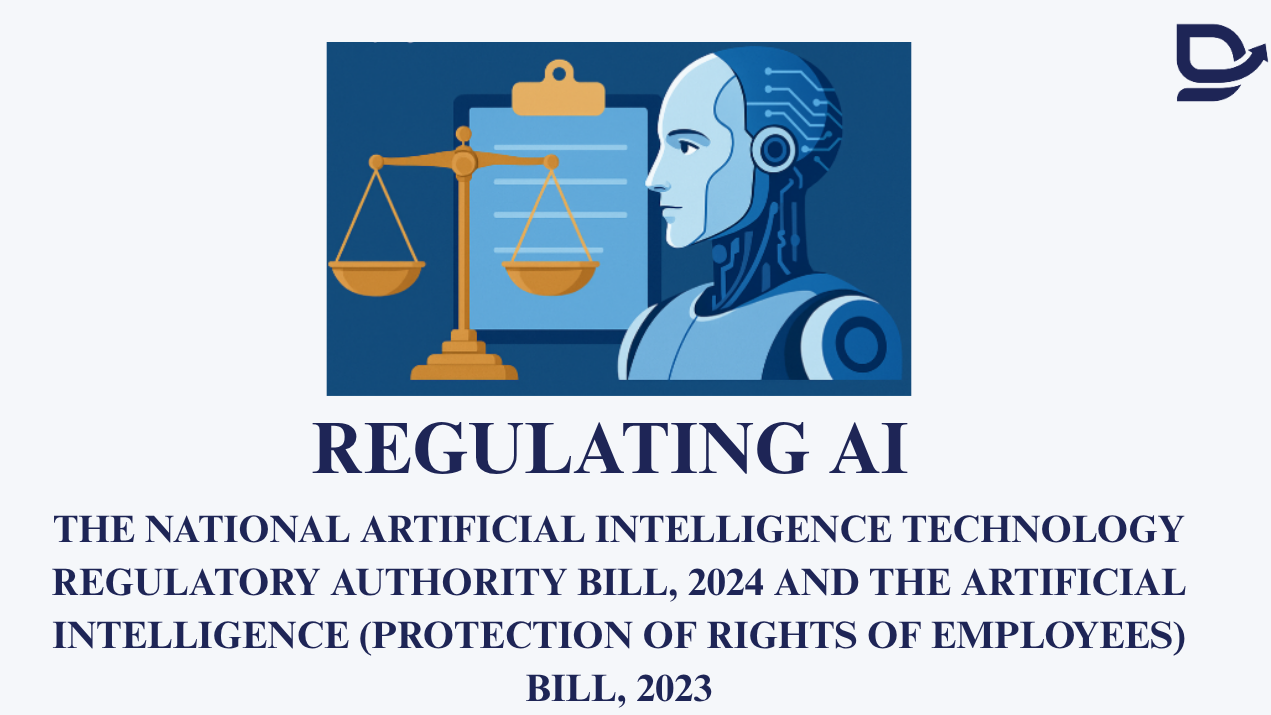
Private member bills on AI regulation have been introduced in the Rajya Sabha - the National Artificial Intelligence Technology Regulatory Authority Bill 2024 and the Artificial Intelligence (Protection of Rights of Employees) Bill 2023. These proposed legislations aim to establish India's first comprehensive regulatory framework for AI governance, addressing deepfake misuse, algorithmic bias, and employee protection in AI-driven workplaces, though their passage remains uncertain.

Highlights of the Bills

The National Artificial Intelligence Technology Regulatory Authority Bill, 2024

Objective: Establishes the National Artificial Intelligence Technology Regulatory Authority (NAITRA) to regulate and monitor the use of artificial intelligence (AI) and related technologies, ensuring ethical deployment and addressing risks like deepfakes.

Key Functions of NAITRA: The Authority will set standards, monitor compliance, promote research, and formulate a national policy for AI regulation. It will have powers of a civil court to enforce compliance and address grievances related to AI, machine learning, and deepfakes.

Deepfake Regulation: Creating or sharing deepfakes without consent or digital watermarks is a criminal offence if intended to humiliate, incite violence, or facilitate fraud. Penalties include up to five years imprisonment or fines as recommended by the National Deepfake Mitigation and Digital Authenticity Task Force.

Environmental and Social Safeguards: The Bill mandates identifying privacy challenges, biases, and employment loss risks due to AI, and coordinating with government departments for risk assessment.

The Artificial Intelligence (Protection of Rights of Employees) Bill, 2023

Objective: Protects employee rights in workplaces using AI by ensuring transparency, fairness, and data privacy in AI implementation.

Employer Obligations: Employers must provide comprehensive documentation on AI use, obtain explicit employee consent, conduct bias-mitigation audits, and offer training for employees affected by AI systems.

Equality Impact Assessment: The government must conduct assessments every five years to ensure AI implementation does not discriminate based on race, gender, or other characteristics.

Funding: The Central Government will provide funds to states to implement the Act's provisions.

Key Issues and Analysis

The National Artificial Intelligence Technology Regulatory Authority Bill, 2024

Lack of Clarity on Appeal Mechanisms for Penalties

The Bill empowers NAITRA to adjudicate penalties for non-compliance, such as unauthorized deepfake dissemination. However, it does not specify an appeal mechanism for penalties imposed by the Authority or the Task Force, unlike other laws like the Jan Vishwas (Amendment of Provisions) Act, 2023, which provide for appeals to higher authorities. This could lead to unchecked authority and potential misuse.

The proposed NAITRA will have civil court powers under Section 5, including summoning witnesses, requiring document production, and receiving evidence on affidavits. While these powers enable effective enforcement, the absence of appellate provisions creates an institutional gap. Organizations facing penalties may have no recourse other than approaching higher courts directly, potentially overwhelming the judicial system and delaying resolution of AI-related disputes.

Inadequate Safeguards for Deepfake Victims

The Bill criminalizes deepfakes intended to harm or deceive but does not outline specific support mechanisms for victims, such as legal aid or compensation. The document notes collaboration with initiatives like Parihar in Bengaluru for victim support, but states that "the available data on the number of individuals seeking assistance from Parihar and the mechanisms employed to aid victims in such cases remains limited," highlighting a gap in implementation.

Current provisions under the Information Technology Act 2000, particularly sections 67 and 67A, address sexually explicit electronic material, while Section 500 of the Indian Penal Code covers defamation. However, these existing frameworks are inadequate for addressing the diverse manifestations of deepfakes, particularly synthetic sexually explicit material used for harassment and blackmail. The Bill's focus on criminalization without comprehensive victim support leaves affected individuals vulnerable during legal proceedings.

Potential Overlap with Existing Laws

The Bill addresses AI-related issues like data privacy and bias, which are partially covered by the Digital Personal Data Protection Act, 2023. This overlap may create confusion in enforcement, as the Bill does not clarify how NAITRA's powers interact with existing legal frameworks.

The Data Protection Authority established under the DPDP Act already handles privacy concerns across sectors, while NAITRA would specifically address AI-related privacy challenges. Without clear jurisdictional boundaries, conflicts may arise when AI systems violate both data protection and AI-specific regulations. This regulatory ambiguity could burden businesses with multiple compliance requirements and create enforcement gaps.

Resource Allocation Uncertainty

Section 7 mandates that the Central Government provide adequate funds to NAITRA after parliamentary appropriation, but the Financial Memorandum acknowledges that "at this juncture, it is difficult to estimate the actual expenditure likely to be involved." The Bill requires establishing headquarters in New Delhi, regional offices, appointing experts, and conducting nationwide monitoring activities without concrete budgetary provisions.

Stakeholder Perspective: "The rapid advancement and proliferation of AI technologies necessitate the establishment of a robust regulatory framework to ensure the ethical, transparent, and accountable use of AI in the Country," states the Bill's objectives.

The Artificial Intelligence (Protection of Rights of Employees) Bill, 2023

Insufficient Mechanisms for Bias Detection

The Bill mandates regular audits to mitigate biases in AI algorithms but does not specify methodologies or tools for detecting complex biases, which are difficult to identify due to "the intricate nature of AI algorithms" complicating comprehension of their impact on decision-making processes. This could undermine the effectiveness of bias mitigation efforts.

Section 3(b) requires mitigation of biases through regular performance audits and impact assessments, but provides no technical standards for conducting these evaluations. AI bias can manifest in subtle ways - from training data that underrepresents certain groups to algorithmic decisions that correlate protected characteristics with performance metrics. Without standardized bias detection protocols, employers may conduct superficial audits that fail to identify discriminatory patterns.

The Bill references a case where "one conglomerate had to discontinue an AI tool designed to screen job candidates' resumes" after the system learned male-dominated hiring trends and downgraded applications from women. Such incidents demonstrate the complexity of algorithmic bias, which requires sophisticated detection methods beyond basic performance metrics.

Limited Scope for Employee Redressal

While employees can refuse AI-based tasks violating their rights, the Bill lacks a clear grievance redressal mechanism for disputes arising from AI implementation. This omission could leave employees vulnerable, especially in cases of wrongful termination or discrimination due to AI-driven decisions.

Section 3(c) grants employees the right to refuse AI-generated processes and review high-risk decisions, but does not establish procedures for exercising these rights. Employees may face retaliation for refusing AI-based tasks or challenging algorithmic decisions. Without institutional protection mechanisms, these rights remain theoretical rather than practical safeguards.

The Bill requires employers to obtain explicit written consent before AI implementation under Section 4, but provides limited guidance on what constitutes meaningful consent or how employees can withdraw consent without professional consequences.

Financial Uncertainty and Implementation Challenges

The Bill requires the Central Government to fund state governments for implementation under Section 6, but the Financial Memorandum states that "it is not possible to estimate the actual expenditure likely to be involved," creating uncertainty about resource allocation and enforcement capacity.

Conducting Equality Impact Assessments every five years across all workplaces using AI systems represents a significant administrative burden. The assessments must evaluate fairness and non-discrimination, requiring specialized expertise in both AI technology and employment law. Without adequate funding, state governments may lack capacity to effectively monitor compliance or conduct meaningful evaluations.

Stakeholder Perspective: "The impact of AI on the workforce cannot be ignored. As AI becomes integral to various decision-making processes within organisations, this Act serves as a critical step toward ensuring fair and unbiased practices in workplaces," according to the Bill's statement of objectives.

Statistical Insights

Recent data reveals the scope of AI-related concerns in India:

Deepfake Proliferation: The Bill references a 2016 incident during a State Assembly Poll where a deepfake video manipulated a political figure's speech, marking "one of the earliest known uses of deepfake technology in India during election campaigning." This incident demonstrated how morphing older footage with new content could create convincing false narratives during critical democratic processes.

Employment Displacement Fears: A Randstad survey found that 74% of Indian employees are worried about losing jobs to AI, significantly higher than their counterparts in the US, UK, and Germany. This anxiety reflects India's position as a major services economy where many roles involve data processing and analysis potentially replaceable by AI systems.

Algorithmic Bias in Practice: A prominent example occurred when one conglomerate discontinued an AI tool for resume screening after discovering it replicated biases favoring male candidates in male-dominated industries, demonstrating how AI systems can perpetuate historical discrimination patterns.

Implementation Timeline: The Bills mandate establishment of regulatory bodies and assessment processes within specific timeframes - NAITRA within six months of act commencement, and the first Equality Impact Assessment five years after the Employee Rights Act implementation.

Comparison with Existing Frameworks

Aspect

Existing Laws (Digital Personal Data Protection Act, 2023)

NAITRA Bill, 2024

AI Employee Rights Bill, 2023

Scope

Data privacy and protection across sectors

AI and deepfake regulation, establishes NAITRA

Employee rights in AI implementation

Authority

Data Protection Authority under DPDP Act

NAITRA with civil court powers

Appropriate Government (Central/State)

Penalties

Fines for data breaches, no specific AI focus

Up to 5 years imprisonment for deepfake offences

No specific penalties, focuses on compliance

Employee Protections

Limited to data privacy rights

Addresses job loss risks broadly

Mandates transparency, consent, and bias audits

Appeal Mechanisms

Appeals to Appellate Data Protection Board

No specified appeal process

No specified grievance redressal

Technical Standards

Detailed data processing requirements

Limited technical specifications

Vague bias detection requirements

Conclusion

These Bills represent India's first comprehensive attempt to regulate AI technologies and protect worker rights in an AI-driven economy. However, significant implementation challenges remain. The NAITRA Bill's lack of appeal mechanisms and victim support systems could undermine its effectiveness, while the Employee Rights Bill's vague bias detection requirements may prove insufficient for complex algorithmic discrimination cases.

Both Bills acknowledge substantial financial requirements without providing concrete budgetary estimates, raising questions about enforcement capacity. The overlap with existing data protection laws requires clarification to prevent regulatory confusion.

Despite these limitations, the Bills address critical gaps in India's legal framework for AI governance. As AI technologies continue advancing rapidly, legislative action becomes increasingly urgent to prevent misuse while enabling innovation. The success of these regulatory frameworks will depend largely on implementation details, adequate funding, and coordination with existing legal structures.

The Bills' passage would position India among the first countries to establish comprehensive AI governance systems, potentially serving as models for other developing economies facing similar technological transformation challenges.


Was this update helpful?

Stay informed

Make your next legal technology decision with more clarity.

Join DreamLegal for independent research, market perspectives, and practical evaluation guidance for legal teams.

Create Free Account