LEGAL RESEARCH
OpenAI Unveils GPT-5 With PhD-Level Legal Capabilities
OpenAI launches GPT-5 with PhD-level expertise, targeting legal coding and research applications worldwide. OpenAI released GPT-5 on Thursday, claiming the artificial intelligence model delivers PhD-l
Share article
OpenAI launches GPT-5 with PhD-level expertise, targeting legal coding and research applications worldwide.
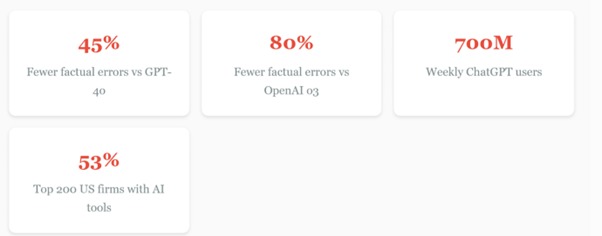
OpenAI released GPT-5 on Thursday, claiming the artificial intelligence model delivers PhD-level expertise in coding and legal research. The San Francisco-based company says the new chatbot reduces factual errors by 45% compared to GPT-4o and offers free access alongside paid subscription tiers. CEO Sam Altman positions GPT-5 as the "biggest single step forward" in AI accessibility for legal professionals globally.
This release matters because legal professionals increasingly face pressure to adopt AI tools for competitive advantage. With 53% of top US law firms already purchasing generative AI tools and 45% using them for legal work, GPT-5's enhanced accuracy could accelerate adoption in document review, legal research, and contract drafting.
GPT-4o vs GPT-5: Technical Improvements
Capability | GPT-4o (Previous) | GPT-5 (Current) |
Factual Accuracy | Baseline error rate | 45% fewer factual errors |
Legal Reasoning | College-level responses | PhD-level expert analysis |
Code Generation | Basic coding assistance | Full application development |
Response Time | Standard processing speed | Optimized faster responses |
Hallucinations | Frequent false information | Real-time fact-checking mechanisms |
Health/Medical Queries | Generic advice | Enhanced medical understanding |
GPT-5 addresses the hallucination problem that has prevented widespread legal adoption. Previous models struggled with multi-step legal reasoning and complex contract analysis, often producing confident but incorrect responses.
"GPT-5 is the first time that it really feels like talking to an expert in any topic, like a PhD-level expert," said Sam Altman, OpenAI CEO, during Wednesday's briefing.
Benefits for Legal Professionals
Legal practitioners gain significant advantages through GPT-5's enhanced capabilities. The model excels at legal document summarization, converting complex statutory language into plain English for client communications. Contract review becomes more efficient with improved extraction of key terms, dates, and obligations.
Legal research sees substantial improvement through better context retention in long conversations. GPT-5 maintains coherent analysis across extended document review sessions, reducing the need to re-establish context. The model's enhanced coding abilities enable lawyers to build custom legal applications without extensive programming knowledge.
GPT-5 demonstrates revolutionary precision in handling complex Word documents, making surgical edits that preserve surrounding context while reliably populating key fields and removing placeholders. The model accurately navigates tabular structures in multi-page agreements, addressing a critical need for transactional lawyers working with legacy precedents spanning 50+ pages.
Junior associates benefit from GPT-5's ability to provide initial drafts of standard contracts, briefs, and memos. The model's improved reasoning helps identify potential legal issues in documents and suggests relevant case law for research starting points.
"You really get the best of both worlds. You have it reason when it needs to reason, but you don't have to wait as long," explained Nick Turley, head of product at ChatGPT.
Early Adopters Report Enhanced Capabilities
Major legal technology companies including Harvey, Spellbook, Legora, and Thomson Reuters received early access to GPT-5, providing initial assessments of its performance in real-world legal applications. These partnerships offer insights into GPT-5's practical advantages over previous models.
Harvey reports significant improvements in complex workflow management through GPT-5's enhanced reasoning and tool orchestration capabilities. The model enables workflows that can branch, loop, and self-correct while maintaining user oversight through interaction and verification systems.
"GPT‑5 lands at the perfect moment. Its stronger reasoning and tool orchestration will enable us to support more complex workflows that can branch, loop, and self-correct – all while keeping users in the driver's seat," said Winston Weinberg, CEO of Harvey.
Spellbook's testing revealed GPT-5 as the first model to consistently identify nuanced, jurisdiction-specific compliance issues that escaped earlier models including Claude 4 and GPT-4o. The model demonstrates enhanced ability to cross-reference jurisdiction requirements, statutory demands, and clause language for automated legal diligence.
"GPT-5 introduces a new level of sophistication in identifying subtle contractual risks. In internal tests, Spellbook found GPT-5 was the first model to consistently flag many nuanced, jurisdiction-specific compliance issues," said Scott Stevenson, CEO of Spellbook.
Thomson Reuters emphasizes GPT-5's multi-layered reasoning capabilities for legal analysis requiring evaluation across multiple documents. The model's contextual understanding proves essential for complex legal brief analysis and case relationship assessment.
Benefits for Legal Technology Vendors
Legal technology vendors can integrate GPT-5's capabilities to enhance existing platforms without rebuilding core infrastructure. Companies like Legora emphasize model-agnostic approaches, working closely with top AI labs to ensure rapid adoption of improved capabilities as they become available.
Document management systems can leverage GPT-5's improved accuracy for automated contract analysis and risk assessment. Practice management software vendors benefit from the model's enhanced coding capabilities to develop custom workflow automation tools.
Legal research platforms gain competitive advantage through GPT-5's reduced hallucination rates. Vendors can offer more reliable AI-powered research tools with greater confidence in accuracy, addressing client concerns about AI-generated legal advice reliability. Thomson Reuters reports using GPT-5 to build deeper contextual understanding in high-stakes legal analysis.
The release of open-source GPT-OSS models allows vendors to deploy AI capabilities on-premise, addressing law firm data security requirements. These models enable customization for specific legal practice areas while maintaining client confidentiality. Early access partnerships with OpenAI provide competitive advantages for companies like Harvey and Spellbook in developing specialized legal applications.
"As the capabilities, speed, and intelligence of AI continue to get exponentially better, we're committed to keeping pace with this rapid speed of innovation," said Max Junestrand, CEO at Legora.
Industry Adoption and Legal Analysis
The legal industry's cautious approach to AI adoption reflects legitimate concerns about professional liability and client confidentiality. Recent Stanford research showing 17% to 33% hallucination rates in legal AI tools has reinforced skepticism among practitioners, making GPT-5's accuracy improvements particularly significant for market adoption.
New York State Bar Association guidelines emphasize that AI should augment rather than replace lawyer judgment. Rule 1.1 of Professional Conduct requires lawyers to maintain technological competency, creating pressure to understand AI capabilities while ensuring proper oversight.
Law firms implementing GPT-5 must establish clear protocols for AI use, particularly regarding client data protection and output verification. Spellbook monitors suggestion acceptance rates to optimize GPT-5 deployment, while companies like Harvey focus on keeping users in control through interaction and verification workflows.
Market competition intensifies as established legal tech companies secure early access advantages. OpenAI's partnerships with Harvey, Spellbook, Thomson Reuters, and Legora demonstrate the strategic importance of close collaboration between AI developers and legal technology providers for optimal implementation.
Industry experts predict GPT-5's improvements will accelerate broader legal AI adoption, with enhanced accuracy addressing primary barriers to implementation. The model's sophisticated contractual risk identification and precision document editing capabilities address specific legal professional needs that previous generations could not reliably handle.
About OpenAI
OpenAI, founded in San Francisco, launched ChatGPT in November 2022, sparking widespread adoption of generative AI technology. The company serves over 700 million weekly users and continues developing artificial intelligence systems aimed at benefiting humanity. OpenAI's models power applications across legal, healthcare, finance, and education sectors worldwide.
Was this update helpful?
Sources
- 1GPT-5 in ChatGPThttps://help.openai.com/en/articles/11909943-gpt-5-in-chatgpt
- 2OpenAI unveils GPT-5, a new flagship AI model with high accuracy and coding powerhttps://siliconangle.com/2025/08/07/openai-unveils-gpt-5-new-flagship-ai-model-high-accuracy-coding-power/
- 3OpenAI says ChatGPT is on track to reach 700M weekly usershttps://techcrunch.com/2025/08/04/openai-says-chatgpt-is-on-track-to-reach-700m-weekly-users/
- 4Why using ChatGPT helps law firms prepare for a generative AI futurehttps://www.draftable.com/draftable-legal-blog/why-using-chatgpt-helps-law-firms-prepare-generative-ai-future
- 5OpenAI ChatGPT-5 release by Sam Altman: Features, how is GPT-5 different from GPT-3, GPT-4?https://economictimes.indiatimes.com/news/international/us/openai-chatgpt-5-release-by-sam-altman-features-how-is-gpt-5-different-from-gpt-3-gpt-4/articleshow/123169577.cms?from=mdr
Continue reading
Related articles
Legal Research
Legora Rebuilds Legal Research Engine With New Ontology and AI-Native Citator
Read article

Legal Research
Lexroom Buys French and Bulgarian Legal AI Firms as European Expansion Shifts to M&A
Read article
Legal Research
Magnar Raises $8 Million to Expand Legal AI Across Latin America
Read articleStay informed
Make your next legal technology decision with more clarity.
Join DreamLegal for independent research, market perspectives, and practical evaluation guidance for legal teams.
Create Free Account