LEGAL TECH

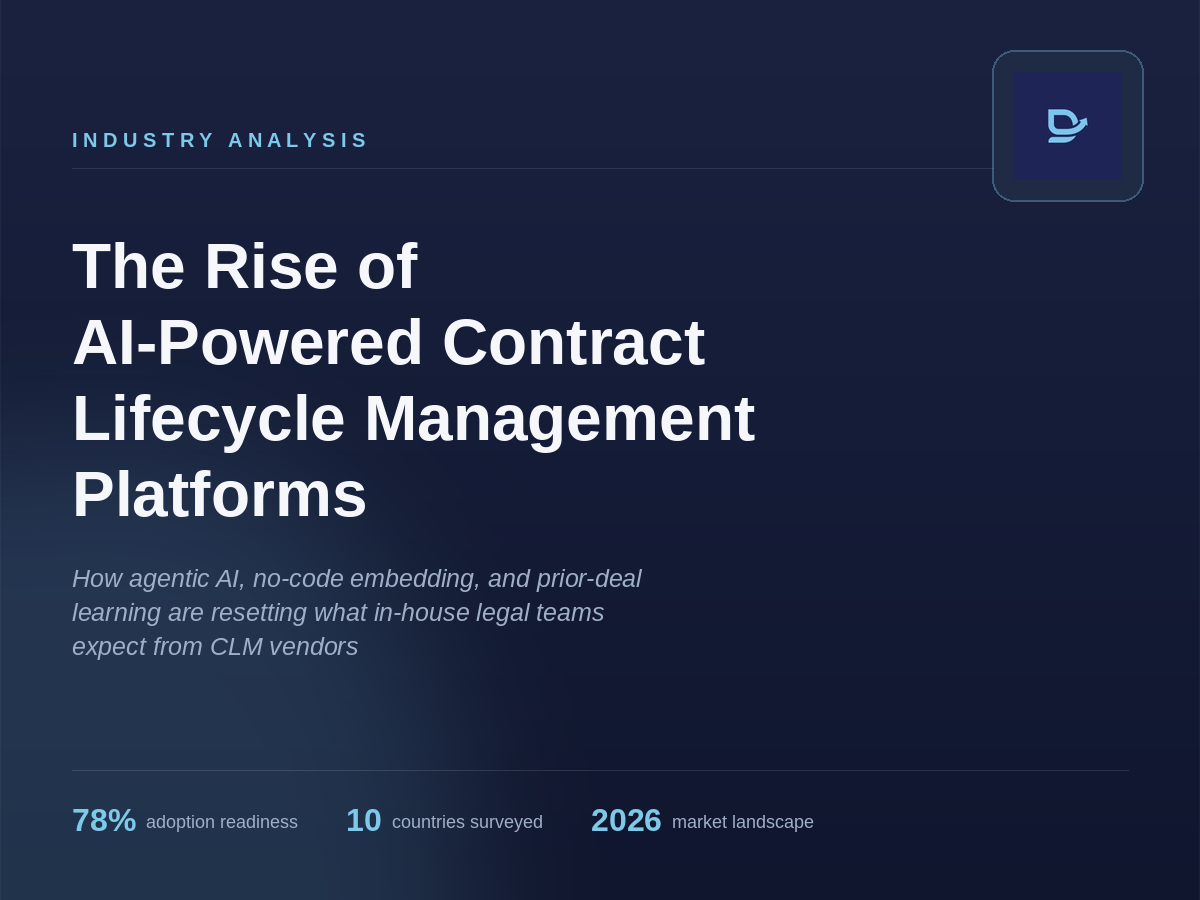
The Rise of AI-Powered Contract Lifecycle Management Platforms

How agentic AI, no-code embedding, and prior-deal learning are resetting what in-house legal teams expect from CLM vendors

24 August 2026 5 min readDreamLegal Research

Share article

The Rise of AI-Powered Contract Lifecycle Management Platforms

The Adoption Window Has Opened

Contract lifecycle management has moved past the pilot stage. A 2026 survey of 1,151 legal professionals across 10 countries, published by DreamLegal research on November 25, 2025, found that 78 percent of respondents are ready to adopt CLM tools to address compliance pressure and operational inefficiency. That figure describes an active purchase cycle, not a future intention. In-house teams have shifted from evaluating whether AI belongs in contracting to deciding which platform to deploy, which shortens the sales window for vendors that are ready and exposes those that are not.

Three developments announced on August 21, 2026 illustrate where the category is heading: no-code CLM embedded directly in systems of record, agentic AI replacing static workflow automation, and prior-deal learning as a way to generate templates from a firm's own transaction history. Each has direct implications for how general counsel evaluate vendors and how vendors need to position their roadmaps.

Three Forces Reshaping the Category

1. No-Code Embedding Inside Systems of Record

Agiloft launched a no-code CLM integration on Salesforce's AgentExchange marketplace on August 21, 2026, positioning itself as the only enterprise CLM provider offering code-free deployment, maintenance, and extension inside Salesforce. The strategic implication is that CLM is no longer a standalone destination product. Buyers want contract functionality embedded where sales, procurement, and finance teams already work, rather than a separate console that requires a new login and a new workflow. Vendors whose roadmaps still assume a dedicated CLM interface are behind this shift.

2. Agentic AI Replacing Static Workflow Automation

Thomson Reuters shipped CoCounsel Legal on August 21, 2026, built on Anthropic's Claude Agent SDK and designed to plan, reason, and execute multi-step legal workflows, combining research, drafting, and matter analysis into one agentic workspace. On the same day, iManage and Thomson Reuters deepened their partnership to connect CoCounsel, HighQ, Noetica, and Legal Tracker through governed knowledge access and Model Context Protocol (MCP) support. The practical takeaway is that contract management is being absorbed into a broader agentic legal workspace, and MCP-based interoperability is becoming a baseline integration standard rather than a competitive differentiator.

3. Prior-Deal Learning as a Differentiator

Avvoka launched Curate on August 21, 2026, a standalone product that scans a firm's prior transaction documents and produces a single lawyer-approved template per document type. The tool identifies the strongest clause versions across closed matters while leaving lawyers in control of final drafting. NetDocuments pursued a related approach, pushing AI-driven tabular review and an expanded Legal Context Graph into its document management system, keeping due diligence and contract audit workflows inside the document repository rather than exporting them to a separate tool.

What In-House Teams Are Actually Buying

The purchasing signal from these launches maps to four specific capabilities general counsel are prioritizing, summarized below.

Capability

Why It Matters to General Counsel

Vendor Signal

No-code deployment inside Salesforce or a CRM

Procurement and sales teams can self-serve without routing requests through legal

Agiloft's AgentExchange integration is the reference architecture

Agentic, multi-step workflows

Reduces handoffs between research, drafting, and review

Thomson Reuters CoCounsel Legal paired with the iManage partnership

Template learning from executed deals

Closes the gap between a firm's stated preferred positions and the market paper it actually signs

Avvoka Curate; NetDocuments' Legal Context Graph

Governed AI with MCP connectors

Supports audit trails and permissioned access to firm knowledge

iManage and Thomson Reuters' joint MCP support


The Category Is Consolidating, Not Just Growing

Standalone CLM point solutions face pressure from two directions at once. Agentic platforms such as CoCounsel are absorbing contract workflows into a broader legal operating system, while document platforms such as NetDocuments are pulling contract review back into the DMS rather than letting it operate as a separate destination. The 78 percent adoption readiness figure from the DreamLegal survey is bullish for total category spend, but it does not guarantee bullish outcomes for any individual vendor, particularly one without an embedding strategy, an agent story, or a governance narrative built around MCP and audit trails.

Large-Firm Signals Confirm the Trend

Adoption at scale is already visible among large firms and service organizations. Linklaters deployed Legora firmwide across 30 offices on September 23, 2025. Epiq Advisory, a services organization with roughly 4,000 people operating in 17 countries, partnered with Legora on August 21, 2026 specifically to convert AI pilots into production systems. The Epiq-Legora partnership underscores that pilot-to-production conversion, not feature parity, is the current bottleneck for enterprise legal AI deployments. Vendors that cannot demonstrate a repeatable path from pilot to production risk losing deals to competitors that can, regardless of how their feature sets compare on paper.

Strategic Questions for Vendors

Before committing product roadmap for the next planning cycle, CLM vendors should be able to answer the following:

1.   Where does your CLM live? If the answer is not inside Salesforce, inside the DMS, or inside an agent, the distribution model is at risk.

2.   What is the MCP story? The iManage and Thomson Reuters partnership has made MCP support a buyer expectation rather than a differentiator.

3.   Can pilot-to-production conversion be demonstrated? The Epiq-Legora partnership signals that buyers are paying for conversion outcomes, not pilot engagements.

4.   Does the platform learn from a firm's executed deals? Avvoka Curate has set a new baseline expectation for template generation grounded in a firm's own closed matters.

Outlook

The window to position as an AI-native CLM provider is open but narrowing. The 78 percent adoption readiness figure from the DreamLegal survey reflects buyers who are actively selecting vendors now, not waiting for product roadmaps to mature. Vendors still rebuilding around agentic workflows heading into 2027 are competing against providers that have already shipped embedded, agentic, and deal-learning capabilities into production. For in-house legal teams, the practical implication is that vendor selection criteria should weight distribution model, MCP-based interoperability, demonstrated pilot-to-production conversion, and the ability to learn from a firm's own contract

Was this update helpful?

Stay informed

Make your next legal technology decision with more clarity.

Join DreamLegal for independent research, market perspectives, and practical evaluation guidance for legal teams.

Create Free Account