Which Sectors Are Actually Buying Legal Tech: A Category-by-Category Breakdown of In-House Legal Technology Adoption
This article breaks down where five major legal tech categories concentrate their in-house adoption, and why.
DreamLegal Market Intelligence tracked 1,123 in-house legal technology clients across categories and geographies. The data shows a clear pattern: adoption is not uniform across the legal tech stack. Each category has a dominant buyer, and the reasons trace back to how each sector operates, not to marketing spend or hype cycles.
This article breaks down where five major legal tech categories concentrate their in-house adoption, and why.
The Overall Market Shape
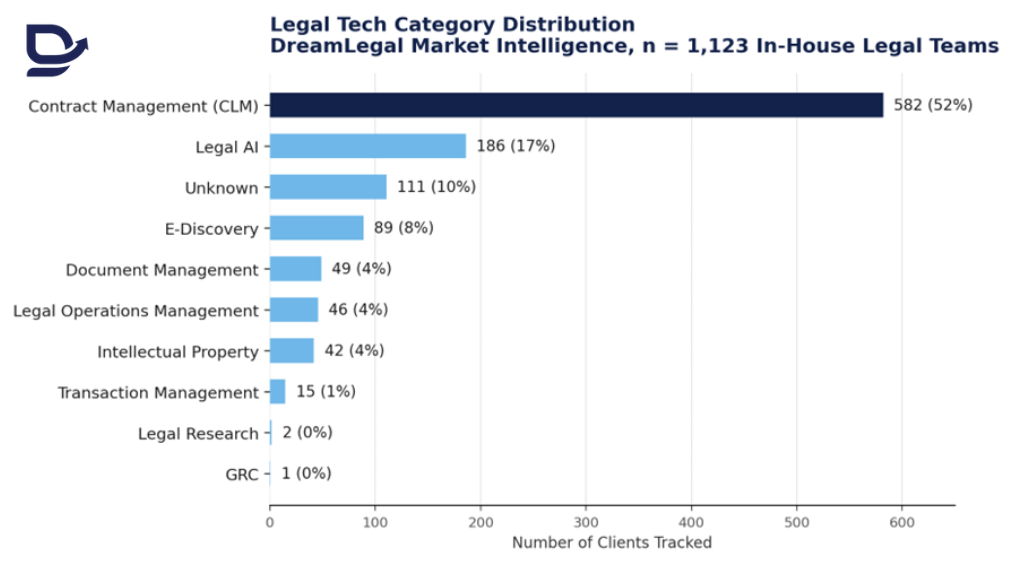
Of the 1,123 clients tracked, contract management (CLM) accounts for 582 clients, or 52% of the total. Legal AI follows at 186 clients (17%), e-discovery at 89 (8%), document management at 49 (4%), intellectual property at 42 (4%), legal operations management at 46 (4%), transaction management at 15 (1%), legal research at 2 (0%), and GRC at 1 (0%). A further 111 clients (10%) fall into an unresolved category.
Geographically, North America accounts for 604 of the tracked companies (54%), Europe for 257 (23%), South Asia for 131 (12%), Asia Pacific for 72 (6%), the Middle East and Africa for 28 (2%), and Latin America for 23 (2%). Eight companies (1%) have no resolved headquarters region.

CLM's 52% share of the tracked market is the single largest signal in the dataset. It confirms that contract volume, not compliance pressure or litigation risk, is currently the primary driver of legal tech spend. The sector breakdown below explains why.
Leading Sector by Category

Contract Lifecycle Management: Software and IT Companies
Software and IT companies lead CLM adoption. Their revenue is generated through contracts: SaaS licensing agreements, vendor contracts, partner and reseller deals, and customer subscription terms. A single enterprise software company can generate hundreds of contract events per month across sales, procurement, and partnerships.
A 2026 survey referenced in DreamLegal's dataset found that 78% of legal professionals report readiness to adopt CLM tools. Among IT companies, this readiness converts to deployment faster than in other sectors, because contract throughput directly limits how fast the business can close deals. When contract review becomes a bottleneck, it becomes a revenue problem, not just a legal department problem. That urgency is what places IT and software companies at the top of CLM adoption.
Document Management: Financial Services
Banks, insurers, and non-banking financial companies (NBFCs) lead document management adoption. The driver is regulatory retention, not convenience. Requirements under SOX, Basel frameworks, and GDPR require financial institutions to retain, classify, and produce documents on demand, often across jurisdictions with different retention periods.
DreamLegal's data specifically notes NBFCs deploying legal notice automation to manage debt collection workflows, a use case that generates high volumes of standardized, time-sensitive documents. This is a narrower and more operational need than general-purpose document storage, and it explains why financial services firms adopt document management tools ahead of other sectors: the documents themselves carry legal and regulatory consequences if mishandled.
GRC: Retail and Consumer Goods
Retail and consumer goods companies lead governance, risk, and compliance (GRC) adoption. Retail supply chains span multiple jurisdictions, each with separate consumer protection statutes, product liability rules, and import and export regulations. A single product line can be subject to different compliance regimes in different markets simultaneously.
India's regulatory environment is cited in DreamLegal's data as a specific example of this fragmentation, referenced in the context of NYAI's funding narrative. Retailers operating in fragmented regulatory markets cannot rely on a single compliance framework, which pushes them toward GRC platforms that can track obligations across jurisdictions in one system.
GRC represents only 1 of the 1,123 tracked clients in the current dataset (0%), the smallest category tracked. This indicates GRC adoption is still in an early stage relative to CLM and legal AI, even within its leading sector.
Legal AI: Financial Services and IT/Tech
Financial services and IT/tech companies lead legal AI adoption, and for the same underlying reason: both sectors combine budget availability with data maturity. Legal AI tools require structured historical data to perform well, and both sectors have spent years building the data infrastructure that AI tools depend on.
DreamLegal's data cites Harvey AI reaching $100 million in annual recurring revenue and GC AI serving more than 2,000 in-house legal teams as indicators of adoption concentration. Legal AI is the second-largest category in the tracked dataset at 186 clients (17%), behind only CLM. This places it well ahead of document management, GRC, and legal operations combined, and confirms that financial services and technology companies are moving faster than other sectors on AI-specific legal tools, not just software adoption in general.
Legal Operations: Accounting Firms and Banking
Accounting firms and banks lead legal operations adoption. Matter management, spend management, and entity management are the three core legal ops functions, and all three map directly onto functions these sectors already run for other parts of their business: accounting firms already manage matters and spend for their own clients, and banks already manage complex entity structures across subsidiaries and jurisdictions.
DreamLegal's data points to Thomson Reuters' partnership with Laurel, which attaches dollar figures to AI usage inside legal workflows, as evidence of this efficiency-first culture. Accounting and banking sectors evaluate legal tools the way they evaluate any other operational spend: by cost per matter and return on tool investment. That measurement discipline is what pulls them ahead of other sectors in legal operations adoption specifically, even though it is not the largest category by client count (46 clients, 4%).
Summary Table
Legal Tech Category | Highest-Penetration Sector(s) | Why |
CLM | Software & IT Companies | High contract volume from SaaS licensing, vendor agreements, and partner deals. 78% of legal professionals report readiness to adopt CLM, and IT companies lead adoption because contracts are their core revenue mechanism. |
Document Management | Financial Services (Banking, Insurance, NBFCs) | Regulatory retention requirements under SOX, Basel, and GDPR require document governance. NBFCs deploy legal notice automation specifically for document-heavy debt collection workflows. |
GRC | Retail & Consumer Goods | Multi-jurisdiction compliance across supply chains, consumer protection rules, and product liability exposure. Fragmented regulatory landscapes, including India's, drive adoption. |
Legal AI | Financial Services & IT/Tech | Both sectors combine budget availability with data maturity. Harvey AI's $100M ARR and GC AI's base of over 2,000 in-house teams show adoption concentrated in these verticals. |
Legal Operations | Accounting Firms & Banking | Matter management, spend management, and entity management are mature operational needs in both sectors. Thomson Reuters' partnership with Laurel, which attaches dollar figures to AI usage, reflects this efficiency-first culture. |
What This Means for Vendors and Buyers
The pattern across all five categories is the same: adoption concentrates where the category's core function maps directly onto a sector's existing operational pressure. IT companies buy CLM because contracts are their revenue engine. Financial services buys document management because retention is a regulatory requirement, not a preference. Retail buys GRC because its supply chains cross more regulatory lines than any other sector tracked. Financial services and IT buy legal AI because they have the data and budget to make it work. Accounting and banking buy legal operations because they already run cost-per-matter analysis for other parts of their business.
For vendors, this means positioning matters more than feature parity. A CLM tool marketed to retail will compete against GRC tools for the same budget line. A legal AI tool marketed to sectors without mature data infrastructure will face adoption friction regardless of the model's quality.
For buyers, the data suggests that category selection should follow operational pressure, not general enthusiasm for legal tech. The sectors in this data are not adopting these tools because they are the most legally sophisticated. They are adopting them because the tool addresses a cost or compliance problem that already exists inside their business model.
Source: DreamLegal Market Intelligence, 2026 (n = 1,123 tracked in-house legal technology clients)
Was this update helpful?