DATA INTEGRATIONS AND APIS
Top 10 Legal API and Integration Tools in 2026, by Buyer Interest
The 10 legal API and data integration tools legal buyers researched most on DreamLegal in October 2026, from court data feeds to AI connectors, with pricing.
A legal API, and the integration tools built around one, lets legal software exchange data with the systems a firm or legal team already runs, such as document management, CLM, Microsoft 365 and AI models, so work moves between them without re-keying. These are the 10 legal API and integration tools legal buyers researched most on DreamLegal in October 2026, ranked by DL Score, with what each does, who it suits and what it costs.
We rank 78 data integration and API products every month by how much interest they attract from legal buyers on DreamLegal: profile views, comparisons, shortlists, downloads and enquiries. The ranking is not a quality score and no vendor can pay to be on it. You can browse every listing in the data integrations and APIs category.
Key takeaways
Axara AI leads the October 2026 ranking, followed by Supervisor by ayfie, PacerPro, Foundation Proactive and Brightleaf.
Data feeds and AI connectors sit side by side: PacerPro delivers court filings into the DMS and Lawstronaut serves 55 million legal records by API and MCP, while Axara AI, Ayfie, GroundX and Hebbia connect AI to documents and company data.
Developers are a clear audience: Axara AI, Ayfie, Brightleaf, GroundX and Lawstronaut all offer an API that other software can call.
Two publish a price: Fliplet from $1,500 a month and Lawstronaut from $79 per user a month. GroundX offers a free account, Axara AI prices its API by usage, and the rest quote on request.
Top 10 legal API and integration tools at a glance
# | Tool | Best for | Standout feature | Pricing |
|---|---|---|---|---|
1 | Developers embedding legal AI in their products | API Gateway with 18 OpenAI-compatible tools | Usage-based API pricing | |
2 | Teams wanting governed AI over company data | Context Engine with data connectors | Custom pricing | |
3 | Litigation and docketing teams at large firms | Court filings saved to the DMS with metadata | Quote on request | |
4 | Law firm business development teams | Relationship signals inside Outlook and Teams | Not published | |
5 | Enterprises migrating legacy contracts to a CLM | Contract data extraction with lawyer review | Not published; free consultation | |
6 | Teams building AI over complex documents | Document parsing pipeline with APIs | Free account; paid pricing on request | |
7 | Global financial institutions | No-code document workflows on one stack | Not published | |
8 | Deal teams and law firms on transactions | Matrix, with market data and document integrations | Quote on request | |
9 | Firms building their own apps and portals | Software built from a prompt, connected to your systems | From $1,500 per month | |
10 | Legal AI builders and GRC teams | 55M+ legal records by API and MCP | From $79 per user per month |
What is a legal API?
A legal API is a programming interface that lets one legal system send data to, or take data from, another: for example, pushing court filings into a document management system, or letting an AI model call a contract review tool. Legal tech integrations built on these APIs connect document management, CLM, CRM, email and collaboration tools so information is entered once and reused.
Tools in this category fall into two groups. Data providers deliver legal content, such as court records or legislation, to other systems. Connectors and platforms link a firm's existing systems to AI assistants and agents, through connectors, Model Context Protocol (MCP) servers or OpenAI-compatible tool definitions, so the AI answers from the firm's own documents and data.
When you need legal API and integration tools
Staff re-key the same data. Court notices, contract terms or client details are typed into several systems by hand.
Your AI can't see your documents. Lawyers paste text into AI tools because nothing connects them to the DMS, data rooms or current law.
You are building your own product. You want to add legal AI or legal data to your own software without building it yourself.
The top 10 legal API and integration tools in 2026
1. Axara AI
Best for: in-house teams and law firms doing high-volume transactional work, and developers who want to embed legal AI.
Axara AI is a legal AI company with four layers: a Legal Intelligence platform for contract review, redlining, drafting and research; AI transformation consulting; senior-supervised legal services; and an API Gateway. The gateway exposes 18 OpenAI-compatible legal AI tools that any LLM or app can discover and call with an API key.
Key features
API Gateway with 18 OpenAI-compatible tools for review, redlining, drafting and notices
Playbook-aware API calls with API key authentication
Auto-review and redline against a team's playbook, plus M-Assist, an AI associate
Strengths: built for developers as well as lawyers; Axara says its platform is SOC 2 compliant with bank-level encryption and is used by Fortune 500 general counsel and NASDAQ 100 legal teams.
Things to check: API pricing is usage-based, and platform pricing is not stated.
Pricing: usage-based API pricing; platform price on request. Axara AI vs Legora vs Lucio
2. Supervisor by ayfie
Best for: organisations, including legal and compliance teams, that want governed AI over their own documents.
Supervisor was Ayfie's product; Ayfie, based in Norway, now presents the Ayfie AI Platform, which connects a company's business data to AI. It includes an AI Assistant that drafts and answers from company knowledge, AI agents and workflows, and a Context Engine that keeps answers grounded in current data.
Key features
One context layer that connects data sources through connectors and indexes knowledge
Works in Slack, Microsoft Teams and Copilot
API to build Ayfie into your own tools
Strengths: permissions carry through, nothing leaves the customer's environment, and customer data does not train models; GDPR listed.
Things to check: Ayfie's website no longer lists Supervisor by name, so confirm which product you are buying.
Pricing: custom pricing.
3. PacerPro
Best for: litigation and docketing teams at large and high-volume law firms.
PacerPro is a court data platform that delivers federal and state court documents, docket sheets, case metadata and party tracking in real time, straight into the firm's document management system. When a filing hits the docket, PacerPro captures it and uploads it to the right DMS workspace with its metadata filled in, replacing the manual chain of forwarding, downloading and filing court notices.
Key features
Court Monitoring for real-time alerts on new filings in tracked cases
Court Search across federal and state court records from one access point
Case Digest summaries and party tracking across courts
Strengths: SOC 2 Type II certified; eleven years of data and twenty million filings from US litigation. PacerPro says 8 of the 10 top US firms use it for court data and that firms capture 25% more filings.
Things to check: coverage is federal courts, with state court coverage available and expanding, so check the courts you need.
Pricing: not published; firms book a walkthrough on their own matters for a quote. PacerPro vs UniCourt
4. Foundation Proactive
Best for: lawyers and business development teams at law firms.
Foundation Proactive, from Litera and powered by Postilize, is a relationship intelligence product. It monitors business changes, leadership shifts and market signals, then recommends actions to the right lawyer at the right time. It is part of Litera's Grow suite and connects relationship, experience and engagement data.
Key features
Client insights delivered inside Microsoft 365, Outlook and Teams
Whitespace and cross-sell opportunities across practice groups
Over 50 integrations, plus relationship strength scoring
Strengths: works alongside Foundation (experience management) and Foundation 365 (legal CRM); Lito, Litera's AI agent, is included for Foundation customers at no extra charge.
Things to check: it is built for business development data, and no Proactive plan prices are stated.
Pricing: not published; contact Litera.
5. Brightleaf
Best for: enterprises with large collections of legacy contracts that need clean, structured data.
Brightleaf is an AI contract data extraction service and software. It applies its own semantic intelligence and natural language processing, with lawyers checking the output, to extract metadata from legacy contracts, then migrates the data and original documents into a CLM system.
Key features
OCR, duplicate removal and a hierarchy built across related documents
Hundreds of pre-configured attributes, plus any custom data point from any contract type
API that connects to a CLM or enterprise system and extracts metadata automatically
Strengths: combines software with review by its own legal team and a Six-Sigma process; its website cites a case study of over 4,000 legacy agreements delivered in 90 days. It lists SOC 2, GDPR, NIST CSF and ISO 9001.
Things to check: specific security controls and hosting arrangements are not detailed on its profile.
Pricing: not published; a free consultation is offered. Brightleaf vs Kira
6. GroundX
Best for: teams building AI over large, complex document sets.
GroundX is a document AI platform, originally built by EyeLevel, that offers APIs and no-code tools to extract, interact with and report on complex documents. Its pipeline parses documents so AI can understand them, and the X-Ray demo shows how each upload is interpreted. EyeLevel has been acquired by Valantor.
Key features
Document parsing pipeline that makes complex files ready for AI
Extract, interact and report workflows in GroundX Studio
REST APIs with a full API reference, plus no-code tools
Strengths: a free account with no setup fees or lock-in contracts, so developers can test before buying.
Things to check: it is a general document AI platform rather than a legal-specific tool, and the change of ownership to Valantor is recent.
Pricing: free account; paid pricing on request.
7. Arteria AI
Best for: global financial institutions that want AI across their document workflows.
Arteria AI is an enterprise AI platform for financial services operations, which the vendor describes as an agentic backbone for those workflows. Its components can be combined for different use cases with no-code configuration, on one tech stack for all documents.
Key features
No-code configuration of combinable components
One tech stack for all documents
Built for complex institutional workflows
Strengths: SOC 2 Type 2 and ISO 27001 certified; offices in Toronto, New York and London; the vendor names tier one financial institutions among its users.
Things to check: the vendor says it serves global financial institutions exclusively, so it is not a fit for law firms or most in-house teams. Its profile is short.
Pricing: not published; demos on request.
8. Hebbia
Best for: deal teams and law firms working on transactions and diligence.
Hebbia is AI for investors, bankers, lawyers, consultants and Fortune 500 companies that analyses large document sets and financial data. It centres on Matrix, a spreadsheet-style workspace where each row is a company or document and each column a question, with AI agents extracting and comparing information across thousands of files.
Key features
Market data from SEC filings, FactSet, S&P Capital IQ, PitchBook, Preqin and more
Document integrations with SharePoint, OneDrive, Box, Dropbox, Egnyte, Intralinks, Snowflake and Databricks
Deal team projects and exports to PowerPoint
Strengths: SOC 2 Type II, ISO/IEC 42001:2023, GDPR and CCPA, AES 256 encryption at rest and no training on user data.
Things to check: its data sources lean towards finance and deal work, so check fit for other practice areas.
Pricing: custom quote; demos available. AlphaSense vs Hebbia
9. Fliplet
Best for: firms that want to build their own internal tools, client portals and apps.
Fliplet is an AI platform for building web and mobile software. Teams describe what they need in a plain-language prompt, review the first draft's screens, permissions, data and logic, then launch it. The software can connect to existing systems, databases and APIs, and automated workflows trigger approvals, updates and follow-ups.
Key features
Software created and changed from plain-language prompts
Connections to systems, databases, APIs and workflows
HTML, CSS and JavaScript editing, version history, and publishing to web and app stores
Strengths: a published price; hosting in Europe (Dublin) or the US (California); editor, reviewer and publisher access levels. Named customers include EY, Clifford Chance and Eversheds Sutherland.
Things to check: it is a platform for building software, so someone on your team still has to design and own each app.
Pricing: from $1,500 a month.
10. Lawstronaut
Best for: legal tech platforms, GRC teams and AI builders who need current law in their products.
Lawstronaut is a legal data infrastructure layer that connects AI agents and software to over 55 million legal records across 181+ jurisdictions. It provides legislation, regulations, case law and guidance through a REST API and an MCP server, with a citation, timestamp and link to the official document for every answer.
Key features
RESTful API with OAuth 2.0 and an MCP server for AI agents
Daily ingestion from 1,105+ official portals, normalised into one schema
Article-level change tracking and horizon scanning for regulatory changes
Strengths: a published price; built by the lawyers behind filerskeepers, with over a decade of commercial law experience.
Things to check: it supplies data, so you need your own product or AI agent to use it.
Pricing: from $79 per user a month.
Legal API and integration pricing: how much does it cost?
Pricing models vary more here than in most categories. Two of the ten tools publish a price, one offers a free account, one prices its API by usage, and the rest quote on request.
Per user: Lawstronaut, from $79 per user a month for its legal data API and MCP.
Platform fee: Fliplet, from $1,500 a month.
Free to start: GroundX offers a free account with no setup fees or lock-in contracts.
Usage-based API: Axara AI prices API calls by usage.
Included: Litera's Lito AI agent comes at no extra charge for Foundation customers.
PacerPro, Hebbia, Ayfie, Brightleaf, Arteria AI and Foundation Proactive quote on request. When you compare quotes, ask what an integration costs to build and maintain: connectors, API call volumes, court coverage, deployment in your own environment and the vendor's own review time are often priced separately.
How to choose the right legal API or integration tool
Decide whether you need data or connections. For court filings, look at PacerPro; for legislation and case law by API, Lawstronaut. To connect AI to your own documents, look at Ayfie, GroundX or Hebbia.
Decide who builds. If your developers will build, Axara AI's API Gateway, GroundX's APIs and Lawstronaut's MCP server are designed for that. Fliplet lets non-developers build apps from a prompt.
List the systems that must connect. PacerPro files into your DMS, Brightleaf migrates into a CLM, Foundation Proactive works in Outlook and Teams, and Hebbia connects to SharePoint, Box and Intralinks.
Check security on paper. Ask for SOC 2 and ISO 27001 reports, as PacerPro, Hebbia and Arteria AI list, and whether your data trains the vendor's AI.
Model the cost at your volume. Per-user, per-call and flat platform pricing behave very differently as usage grows.
Shortlist three tools and compare them side by side on DreamLegal, for example PacerPro vs UniCourt or Brightleaf vs Kira.
Frequently asked questions
What is the best legal API?
There is no single best legal API: the right one depends on the data you need and who will do the work. Developers embedding legal AI look at Axara AI's API Gateway; litigation teams that need court filings look at PacerPro; AI builders that need current law look at Lawstronaut; deal teams look at Hebbia. This list shows which tools legal buyers research most, as a starting shortlist.
What is the most popular legal API and integration tool?
On DreamLegal, Axara AI was the data integration and API tool legal buyers researched most in October 2026, followed by Supervisor by ayfie, PacerPro, Foundation Proactive and Brightleaf. The ranking is updated every month.
What is a legal data API?
A legal data API lets software read legal content, such as legislation, case law or court filings, from a provider. Lawstronaut serves over 55 million legal records across 181+ jurisdictions by REST API and MCP, and PacerPro delivers court filings and docket data into a firm's document management system.
Is there a court data API in this list?
Yes. PacerPro captures federal and state court filings, docket sheets and case metadata as they hit the record and files them in the firm's DMS, with Court Monitoring alerts and Court Search across courts. Lawstronaut also covers case law alongside legislation and regulations.
Which legal tech integrations matter most for law firms?
Usually document management, CRM and Microsoft 365. In this list, PacerPro files into the DMS, Foundation Proactive works in Outlook and Teams with over 50 integrations, Ayfie works in Slack, Teams and Copilot, and Hebbia connects to SharePoint, Box and Intralinks.
How much does a legal API cost?
It depends on the model. Lawstronaut starts at $79 per user a month, Fliplet at $1,500 a month, GroundX offers a free account, Axara AI prices its API by usage, and the rest quote on request.
Do legal API tools use AI?
Most do. Axara AI exposes legal AI tools to other software, Ayfie and GroundX ground AI in company documents, Hebbia runs AI agents across thousands of files, Brightleaf uses NLP for contract extraction, and Lawstronaut feeds current law to AI agents with citations.
Can these tools keep data in my own environment?
Some say so. Ayfie says nothing leaves the customer's environment and customer data does not train models, Hebbia lists no training on user data, and Fliplet lets you choose hosting in Europe or the US.
How we ranked these legal API and integration tools
This list is ranked by the DL Score, DreamLegal's monthly measure of buyer interest. Every month we rank each product in its category by how legal buyers engage with it on DreamLegal: how often its profile is viewed, how often it is compared with other tools, shortlisted, downloaded and enquired about. This edition uses the October 2026 category ranking across 78 data integration and API products.
What it measures: which legal API and integration tools legal buyers are actively researching right now.
What it does not measure: product quality or fit for your team. A tool lower down, or not listed, may suit you better.
What it can't be: bought. Vendors cannot pay for a place, and we never adjust ranks by hand.
Who is listed: only products with a complete DreamLegal profile that do this job. Products filed here that do something else are left out.
How we describe each tool: from its DreamLegal profile and the vendor's own website. Prices are only those the vendor publishes.
How often we update it: every month, after the DL Score is recalculated.
Related on DreamLegal
Compare tools
Add the tools from this article, then search for more.
 PacerPro
Foundation Proactive
 GroundX
Read next
Data Integrations and APIs
The Expanding Legal AI Ecosystem: The Shift Towards Connected Legal Workflows
ReadWas this update helpful?
Products mentioned







Continue reading
Related articles
Data Integrations and APIs
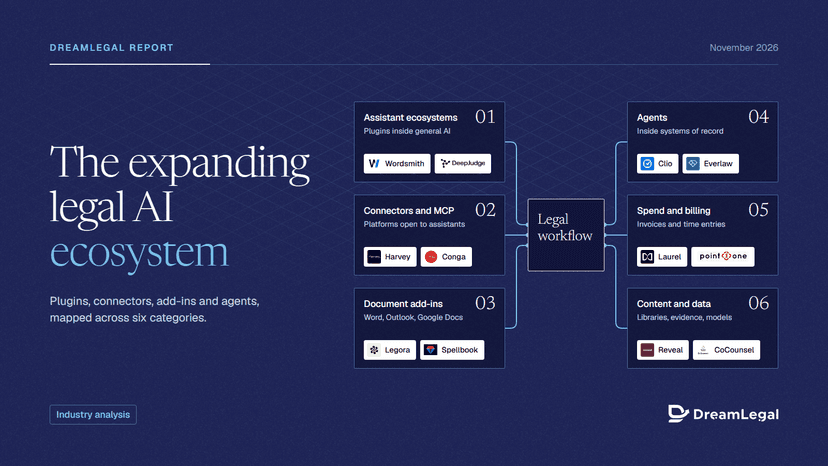
The Expanding Legal AI Ecosystem: The Shift Towards Connected Legal Workflows
How plugins, connectors, document applications and agents are carrying legal AI out of the standalone assistant and into the systems where legal work is drafted, recorded, reviewed and billed.
Read article
Data Integrations and APIs
JUNE's MCP V10 Plugs AI Assistants Into Law Firm Case Files
Read article
Data Integrations and APIs
Descrybe Legal Engine Lands in Microsoft 365 Copilot as Default Connector
Read articleStay informed
Make your next legal technology decision with more clarity.
Join DreamLegal for independent research, market perspectives, and practical evaluation guidance for legal teams.
Create Free Account